Hamburg Heavy Construction & Maritime Vertical Logistics
Used Construction Hoist Suppliers & Factory in the Hamburg Market
Industrial white paper and procurement directory for verified, CE-compliant, rack-and-pinion vertical access equipment deployed across HafenCity, Elbe river industrial corridors, and European infrastructure mega-projects.
Direct Yard Stock · Ready For Hamburg Dispatch
Certified High-Rise Vertical Hoists (Hamburg Port Verified)
Pre-inspected rack-and-pinion twin and single-cage construction elevators with verified load profiles, variable frequency drives, and cold-climate coastal sealing ready for Hamburg job sites.
Hamburg Certified
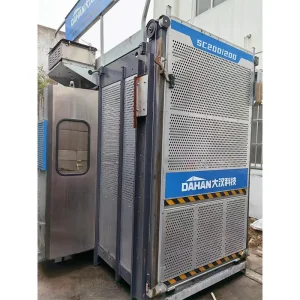
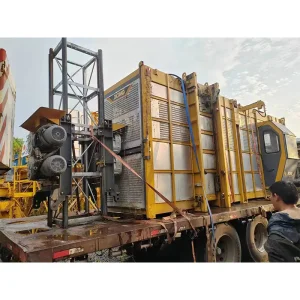
Hamburg Port Project: DAHAN SC200/200 (YOM 2019–2023)
Vertical Access Equipment Realities in Hamburg & the North German Plain
Hamburg, the second-largest city in Germany and Europe's third-busiest container port, presents a distinct set of urban and industrial construction dynamics. The city's landscape is defined by extensive maritime infrastructure, historic red-brick warehouse conversions (Speicherstadt), the continuously evolving HafenCity waterfront redevelopment, and major brownfield transformations along the southern banks of the River Elbe in Wilhelmsburg and Harburg. Concurrently, large-scale civil engineering undertakings—including the Köhlbrandbrücke replacement logistics corridors and industrial modernization within the Finkenwerder aviation cluster (Airbus manufacturing facilities)—demand rigorous, high-efficiency vertical transportation solutions for both personnel and heavy construction materials.
In the Hamburg market, the utilization of pre-owned (used) construction hoists has shifted from an ad-hoc budget compromise into an intentional, highly engineered fleet strategy. General contractors (Bauunternehmen) and equipment leasing houses operating throughout Northern Germany face significant macroeconomic constraints: lengthy lead times for factory-new machines exceeding 9 to 14 months, steep upfront capital expenditures during prolonged high-interest regimes, and aggressive milestone penalty clauses on flagship urban developments. Inspected, late-model used rack-and-pinion hoists (primarily Year of Manufacture 2018–2023) bridge this operational divide by providing immediate dispatch capacity at 40% to 60% lower capital outlay while strictly complying with the exacting requirements of European standard DIN EN 12158-1 and German occupational health code DGUV Vorschrift 52/53.
Technical Imperative: The Maritime Microclimate Factor
Unlike inland European building hubs like Munich or Frankfurt, construction elevators deployed across Hamburg operate within a high-humidity maritime boundary zone influenced by the North Sea. Mast ties, rack gears, driving pinions, and electrical control cabinets must resist wind-driven saline mist and sudden North German storm squalls (Sturmtief). High-performance used hoists sourced for Hamburg require verified hot-dip zinc galvanization, minimum IP65-rated inverter enclosures, and specialized cold-weather lubricants capable of functioning smoothly down to -20°C.
Global Supply Dynamics vs. Localized Capital Efficiency
On a macro-industrial scale, the construction hoist manufacturing ecosystem has become heavily concentrated within Tier-1 Chinese manufacturing conglomerates (DAHAN, GAOLI, TEWEI, XCMG, ZOOMLION) alongside established European lineage brands such as Potain and Alimak. These global OEMs engineer modular mast systems using high-tensile manganese alloy steel (such as Q355B or S355JR), robotic welding techniques, and standardized rack modules (Module 8 / Module 10). Consequently, late-model used hoists sourced from controlled inventory yards retain superior structural integrity even after initial multi-year deployments in high-density residential and bridge construction.
For engineering contractors operating in Hamburg, sourcing certified used hoists from dedicated global consolidation yards like Huaian Zhongqiang eliminates the friction of single-job depreciation. When paired with structured pre-export recalibration—including the replacement of high-wear components such as guide rollers, safety drop limiters (SAJ series), and drive pinions—contractors secure machines with an operational lifespan expectation exceeding 12 to 15 additional years at an optimal total cost of ownership (TCO).
55%
Average CapEx Savings
128
Pre-Export Testing Points
0.01mm
Gear Clearance Tolerance
14 Days
Average Transit to Port Hamburg
Urban & Civil Engineering Deployments
Localized Application Scenarios Across Greater Hamburg
Engineering-grade vertical hoists tailored to the specific geometric, environmental, and logistical challenges of northern German job sites.
HafenCity & Elbe Waterfront High-Rises
Vertical access operations on tall concrete cores along the Elbe river face severe wind loads exceeding Beaufort force 8. Twin-cage SC200/200 hoists equipped with integrated anemometer cutoff circuits, variable frequency soft-start systems, and robust tie-in brackets accommodate building movements and wind gusts without structural resonance.
High-Speed VFD · Wind Resilient
Industrial Dockyard & Shipyard Refits
Maintenance facilities across Blohm+Voss, Altenwerder, and Steinwerder require heavy payload transport for ship conversion crews, welding rigs, and sandblasting machinery. Heavy-duty hoists with 3.2-meter elongated cages, extra-wide ramp doors, and reinforced flooring handle localized concentrated loads up to 2,000 kg per cabin.
Marine C5 Coatings · Heavy Payloads
Speicherstadt Historic Envelope Restoration
Conserving Hamburg's UNESCO-protected brick architectural ensemble requires vertical transport with zero ground disruption and strict acoustic damping. Low-noise helical gear drive units combined with lightweight, standalone anchoring systems prevent structural vibration transfer into fragile historic facades.
Acoustic Shielding < 68 dB · Zero Facade Shock
Major Civil Infrastructure & Bridge Pylons
The continuous maintenance and upcoming replacement projects for major arterial bridges (such as the Köhlbrand and Elbe highway tunnels) demand vertical access heights up to 150+ meters on inclined or irregular pylon faces. Modular curved and tilted mast tie systems allow rapid customization on civil pylons.
Inclined Mast Ties · Extreme Rigidity
Fast-Track Prefabricated Timber Construction
Modern residential districts in Wilhelmsburg and Altona increasingly mandate sustainable Mass Timber and hybrid CLT (cross-laminated timber) construction. Fast, high-capacity material hoists provide smooth vertical delivery of pre-cut timber modules without causing edge splintering or impact damage.
Micro-Level Deck Leveling · Smooth Glide
Finkenwerder Cleanroom & Aero Infrastructure
Aero-industrial facilities require dust-suppressed, low-emissions vertical elevators during hangar structural expansions. Units outfitted with low-friction sealed bearings, shielded cabling, and secondary drip trays prevent any environmental hydrocarbon contamination.
Eco-Shield Oil Trays · Clean-Drive Tech
Engineering Roadmap & Technological Evolution
The Technical Evolution of Rack-and-Pinion Vertical Access
The second-hand vertical access machinery sector is undergoing a profound technological transformation driven by digitalization, functional safety architectures, and EU-wide energy efficiency directives. Historically viewed as basic mechanical workhorses, modern rack-and-pinion elevators incorporate advanced mechatronics that dramatically elevate job site productivity while mitigating human error risks.
For German fleet managers, purchasing a used hoist manufactured between 2019 and 2023 represents an inflection point: these machines already house digital bus protocols, advanced inverter technology, and precision load cells, allowing effortless retrofitting to match the emerging standards of Industry 4.0 job sites.
Every unit supplied by Huaian Zhongqiang undergoes rigorous pre-export commissioning to ensure seamless integration into European workflows. Our on-site testing yard in Huai’an simulates high-cycle operational conditions before any component is packed for ocean transit:
Structural Metrology & Non-Destructive Testing (NDT): Ultrasonic flaw detection across critical weld seams of mast section corner tubes, cage suspension yokes, and tie-in collar joints. Rejection of any mast showing dimensional deviation greater than ±0.8 mm.
Drive Unit Overhaul: Disassembly, degreasing, and ultrasonic inspection of worm-gear and helical reducers. Replacement of all oil seals with high-temperature viton seals and refill with low-viscosity synthetic industrial gear oil.
Progressive Safety Device (Fall Arrestor) Recalibration: Dynamic drop testing on our dedicated test tower. SAJ series safety devices are verified to lock within 0.15–0.25 seconds under full rated load conditions, calibrated strictly against DIN EN 12158-1 benchmarks.
Electrical & Limit Switch Redundancy: Replacement of all mechanical micro-switches for upper/lower terminal limits, door interlocks, and emergency stops with genuine Schneider or Omron sealed limit assemblies.
Macro Engineering Integration
Integrated Job Site Logistics: Hoist & Tower Crane Synergy
Optimizing vertical workflow economics across high-density German urban building envelopes.
Tower Crane Cycle Optimization
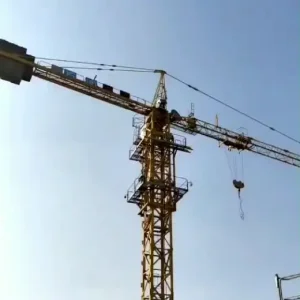
By shifting all personnel, interior finishing materials (drywall, facade brackets, HVAC units, glazing panels) to high-speed dual-cage hoists, tower cranes remain 100% dedicated to structural concrete casting, steel framing, and precast beam placement. This reduces crane idle time by up to 42%.
Subcontractor Shift Management
Twin-cage hoists operating on independent frequency drives allow independent scheduling: Cage A serves dedicated personnel shifts during morning ingress and lunch changeovers, while Cage B operates continuously on automated calling cycles for dry-lining and electrical installation teams.
Integrated Tie-In & Bracing Strategies
Consolidated structural engineering packages: our engineering bureau calculates combined foundation reactions and anchors mast ties directly into building slab floor plates or shear walls using standardized Hilti chemical anchoring configurations validated by German structural engineers (Prüfstatiker).
Our sales engineering department provides complete equipment dossiers, foundation reaction blueprints, and fixed ocean freight schedules to Port of Hamburg terminal facilities.
Frequently Asked Questions: Hamburg & EU Equipment Imports
Practical answers covering compliance, import tariffs, maritime transit, and German job site commissioning.
Are used construction hoists from China compliant with German UVV and CE regulations?
Yes. All late-model hoists supplied by Huaian Zhongqiang for the European market originate from established manufacturers (DAHAN, GAOLI, TEWEI, XCMG, ZOOMLION) built according to the European Harmonized Standard EN 12158-1:2021. Prior to dispatch, each machine undergoes an extensive 128-point UVV checklist review. Original CE Declaration of Conformity certificates, comprehensive operating manuals in German/English, electrical schematics, and individual drop-test certificates for the SAJ progressive safety devices are provided to facilitate immediate certification by local testing organizations (TÜV, DEKRA, or certified Sachverständige).
How is sea freight handled to the Port of Hamburg, and what is the transit timeline?
Hoists are carefully disassembled at our 30+ acre consolidation facility in Huai'an, Jiangsu. Mast sections, cage enclosures, drive pods, and cable trolleys are nested, corrosion-inhibited, and securely lashed into 40ft High Cube (40'HC) containers or 40ft Open Top (OT) units for over-height base enclosures. Shipments route through Shanghai or Ningbo deep-water ports directly to the container terminals in Hamburg (Waltershof, CTA Altenwerder, or CTT Tollerort). Typical ocean transit time ranges from 28 to 35 days, with complete digital bill of lading, commercial invoice, packing list, and EUR.1/Certificate of Origin delivered well before vessel arrival.
What is the typical condition and remaining service life of your used inventory?
We selectively procure units strictly between Year of Manufacture (YOM) 2018 and 2023. These hoists typically exhibit less than 3,000 to 5,000 recorded operational hours on high-speed VFD motors. Because mast structures are crafted from heavy-gauge Q355B structural steel and hot-dip galvanized, structural degradation is minimal. Following our thorough factory refurbishment—replacing all high-wear guides, roller bearings, brake linings, and seals—contractors can expect an additional 10 to 15 years of dependable service life with standard preventative maintenance.
Can we send our own inspector or third-party engineering agency before shipment?
Absolutely. We actively encourage pre-purchase inspections. Buyers are welcome to visit our yard in Huai'an directly, or commission accredited global testing agencies such as SGS, Bureau Veritas, or TÜV Rheinland China to execute comprehensive physical witness testing, structural non-destructive testing, and live functional drop-testing. Additionally, we provide multi-angle high-resolution 4K video inspections and live video walk-throughs for every machine in your order.
How are replacement parts and warranty issues supported in Germany?
Standard consumable components—including guide rollers, contactors, limit switches, and braking coils—utilize standardized international components from Schneider Electric, Siemens, and SEW-Eurodrive, which are readily available off-the-shelf throughout Germany. For structural elements, rack sections, and OEM-specific gear sets, we maintain a dedicated fast-track air-freight spare parts supply line delivering genuine parts directly to your Hamburg facility within 3 to 5 business days.
Comprehensive Machinery Inventory
Complete Used Hoist & Tower Crane Roster for Northern Germany
Select from verified, pre-tested vertical hoists and complementary tower cranes engineered to streamline urban job site logistics.