YOM 2019-2023
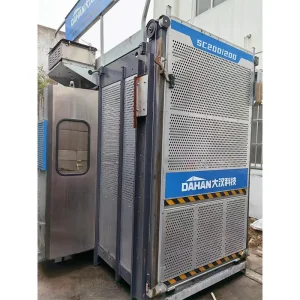
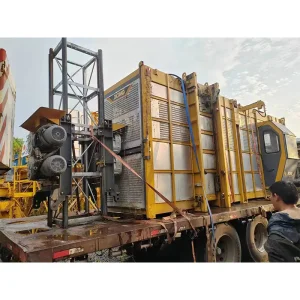
Pre-inspected dual-cage rack and pinion passenger/material hoists (YOM 2019-2023) ready for containerized shipping to Puerto Caldera and Puerto Limón.
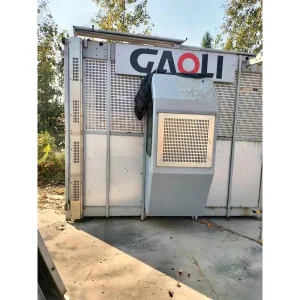
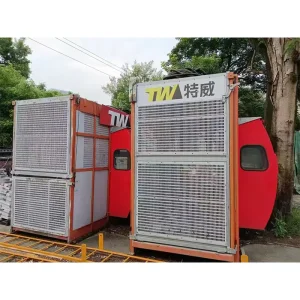
Understanding the confluence of strict seismic engineering, rapid urbanization in the Greater Metropolitan Area (GAM), and maritime environmental stresses across Costa Rican provinces.
Costa Rica's commercial building sector has entered a decisive vertical shift. In key commercial and residential nodes such as San José (notably Rohrmoser, Sabana, and Escalante), Escazú, and Santa Ana, horizontal land constraints coupled with municipal density incentives have accelerated multi-story towers ranging from 18 to over 30 stories. This rapid densification has rendered traditional, low-speed material hoists obsolete.
General contractors and structural developers operating across Costa Rica require high-efficiency, dual-cage rack-and-pinion builder elevators capable of moving up to 4,000 kg (2,000 kg per cage) simultaneously. Such throughput is essential to maintain pouring schedules, dry-wall distribution cycles, and mechanical trades ingress without creating bottlenecks on limited urban footprints.
Simultaneously, the Pacific littoral corridor—principally Guanacaste's Papagayo Gulf, Tamarindo, and Santa Teresa—is experiencing a multi-billion-dollar surge in high-tier eco-resorts, branded condominiums, and wellness architectural complexes. Construction sites in these remote regions present distinct logistical challenges: severe gravel access roads, high tropical UV exposure, and saline coastal air that degrades unprotected steel structures.
On the Atlantic coast, the development surrounding APM Terminals Moín and the Ruta 32 logistics modernization has heightened the demand for industrial vertical lifts and robust maintenance hoists. Heavy multi-tier cold-storage facilities, grain terminal towers, and port storage sheds necessitate heavy-duty hoists capable of operating under high rainfall cycles exceeding 3,500 mm annually.
Addressing the specific electrical grid parameters, dynamic seismic demands, and tropical anticorrosion requirements of Costa Rica.
While domestic machinery in China operates on a 50 Hz cycle, Costa Rica's national power grid (managed by ICE and CNFL) runs on 60 Hz at 208V / 480V 3-phase. Zhongqiang retrofits each unit with Schneider or Yaskawa Variable Frequency Drives (VFD) and rewound 60 Hz helical gear-motors, ensuring continuous torque without thermal tripping during peak ambient temperatures.
Costa Rica is situated within the circum-Pacific seismic belt. Vertical hoists erected against reinforced concrete structures must accommodate inter-story drift during seismic events. Our engineering team provides custom-calculated telescoping wall-ties and anchor brackets fabricated from certified Q345B structural steel, withstanding peak ground accelerations up to 0.4g.
To resist Guanacaste's maritime salt-spray and Limón's heavy tropical rain, every mast section, drive plate, and cage chassis undergoes hot-dip galvanization or high-build marine epoxy primer application. Racks and pinions are forged from 40Cr alloy steel and subjected to high-frequency induction hardening to ensure minimum wear under abrasive sand and humidity conditions.
| Performance Specification | Standard SC200/200 Hoist | High-Speed VFD Model (Costa Rica Spec) | Heavy-Industrial Cargo Hoist (SC300) |
|---|---|---|---|
| Rated Lifting Capacity | 2 × 2,000 kg (Twin Cage) | 2 × 2,000 kg (Twin Cage) | 2 × 3,200 kg (Twin Cage) |
| Hoisting Speed | 0 – 36 m/min (Direct-On-Line) | 0 – 63 m/min (Stepless VFD) | 0 – 40 m/min (Heavy Torque VFD) |
| Cage Internal Dimensions (L×W×H) | 3.2 m × 1.5 m × 2.5 m | 3.2 m / 3.8 m × 1.5 m × 2.5 m | 4.0 m × 1.6 m × 2.6 m |
| Mast Section Dimensions | 650 × 650 × 1508 mm (Q235/Q345) | 650 × 650 × 1508 mm (Hot-Dip Galv.) | 800 × 800 × 1508 mm (Heavy Frame) |
| Safety Device Model | SAJ40-1.2 Progressive Fall-Arrester | SAJ50-1.4 Micro-Inertia Device | SAJ60-1.6 Bi-directional Arrestor |
| Operational Voltage / Frequency | 380V / 50 Hz (Standard) | 480V / 60 Hz (Costa Rica Standard) | 480V / 60 Hz (ICE Industrial) |
| Seismic Interlock Ties | Standard Rigid Bracket | CSCR-2010 Articulated Elastic Ties | Reinforced Strut Anchor Brackets |
Purchasing second-hand lifting equipment requires rigorous verification. Huaian Zhongqiang applies an institutional audit protocol across our 30+ acre facility prior to sea freight allocation.
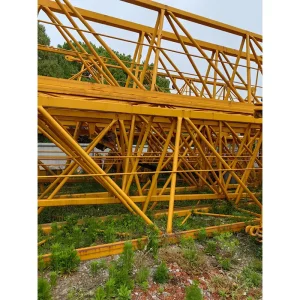
Every tubular chord, diagonal brace, and cage hanger bracket undergoes Ultrasonic Testing (UT) and Magnetic Particle Inspection (MPI) to detect micro-cracks or subsurface metal fatigue in primary load-bearing welds.
Triple-motor drive systems are fully dismantled. High-speed worm reduction gears are measured with dial indicators for gear backlash. Electromagnetic brake discs are renewed, ensuring zero slippage under 125% rated overload conditions.
The progressive safety arrestor is the life-critical fail-safe of rack-and-pinion hoists. Every safety device is recalibrated on a specialized dynamic test bench, calibrated to lock within 0.15m to 1.4m of free-fall velocity, complete with certified test papers.
A streamlined procurement guide for project directors, site logistics engineers, and commercial managers importing construction machinery into Costa Rica.
Under the regulations established by the Colegio Federado de Ingenieros y de Arquitectos de Costa Rica (CFIA), vertical lifting apparatuses on civil sites must undergo structural endorsement by an accredited mechanical engineer (Ingeniero Mecánico Colegiado). Zhongqiang delivers comprehensive factory assembly blueprints, original manufacturer load charts, and structural stress calculation sheets translated into English and Spanish.
This transparent documentation package allows your responsible resident engineer to present certified calculation dossiers to CFIA inspectors without costly site delays or municipal stop-work notices.
Workplace occupational hazard coverage under the Instituto Nacional de Seguros (INS) requires documented adherence to strict machinery safety criteria. Our used hoists maintain operational compliance with all INS checklist items:
Huaian Zhongqiang holds independent import and export operating rights. Our in-house marine rigging crew packs, marks, and lashes mast sections, cages, and drive components inside 40-foot High Cube (40HQ) containers or on Open Top/Flat Rack units:
Primary sea route for consignments intended for San José, the GAM area, and Guanacaste luxury resorts. Ocean transit time from East China ports (Shanghai/Ningbo) typically spans 24 to 28 days.
Strategic entry point for industrial developments along the Caribbean corridor and direct highway transit into eastern San José industrial districts via Ruta 32.
Integration of intelligent IoT telemetry, regenerative energy braking, and solar-integrated vertical lifts for sustainable building projects.
Costa Rican contractors can integrate cloud-linked sensor units into their used hoist cabins. Real-time logging of passenger cycles, current amperage draw, brake lining wear, and vibration frequency enables predictive maintenance, minimizing site downtime in locations far from central service depots.
In harmony with Costa Rica's National Decarbonization Plan and green building credentials (LEED & EDGE certifications), next-generation retrofits utilize regenerative variable-frequency braking modules that feed downward gravitational kinetic energy back into the job site's local power grid.
As tropical building continues expanding along coastal estuaries, hoist components are transitioning from raw zinc plating to thermal-diffusion zinc coatings and self-lubricating polymer guide rollers that resist tropical mold, humidity, and atmospheric marine salts without frequent chemical lubrication.
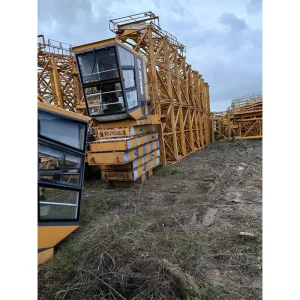
Every listed machine has undergone 100% pre-shipment structural and operational testing at our Huai'an yard. Complete video dossiers and nameplate verifications are available on request.
Direct answers covering customs clearance, electrical frequency retrofitting, freight shipping times, and on-site assembly safety.