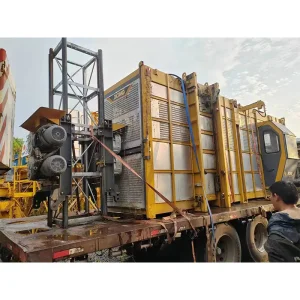
Pre-selected, high-frequency variable frequency (VFD) passenger and materials hoists ready for prompt export to the Nagoya Bay Port complex.
Nagoya, the capital of Aichi Prefecture, stands as Japan's third-largest metropolitan economy and the epicentre of the Chubu industrial powerhouse. The local construction landscape demands unprecedented equipment reliability.
The skyline surrounding Nagoya Station (Meieki) and the commercial axis of Sakae is undergoing substantial densification. With the anticipated extension of the Chuo Shinkansen Maglev terminal, mixed-use commercial supertalls and seismic-reinforced structures require vertical access equipment that operates within constrained, zero-clearance footprints.
Surrounding regions including Toyota City, Kariya, and Komaki host critical clusters of precision manufacturing. The rapid build-out of automated cleanrooms, EV battery production plants, and semiconductor warehousing demands hoists engineered for heavy material pallet intake rather than purely manual crew conveyance.
Direct exposure to Ise Bay requires lifting machinery to feature superior anti-corrosion galvanized surface treatments and multi-tier failsafe arrestors compliant with the strict oversight of Japan's Industrial Safety and Health Act (ISHA) and Ordinance on Safety of Cranes.
Navigating global supply chain volatility through inspected, tier-one second-hand equipment acquisition.
Lead times for newly manufactured passenger-material hoists from European and domestic Japanese OEMs frequently extend between 8 to 14 months due to microchip shortages and elevated raw structural steel indices. For tier-1 general contractors (Zenekon) and regional subcontracting joint ventures in Aichi, waiting on new inventory risks project milestone liquidation damages.
Procuring low-hour, verified used units manufactured between 2018 and 2023 offers immediate deployment cycles within 2 to 3 weeks via maritime shipment through East China sea ports, reducing capital expenditure overheads by 45% to 60%.
The construction sector faces stringent Scope 3 emissions reporting. Reintegrating fully serviced, factory-calibrated hoists prevents the carbon expenditure associated with raw steel smelting, casting, and primary manufacturing. As Japanese developers embrace Green Building certifications (such as CASBEE and LEED Japan), integrating high-efficiency VFD used hoists creates a quantifiable reduction in overall project embodied carbon.
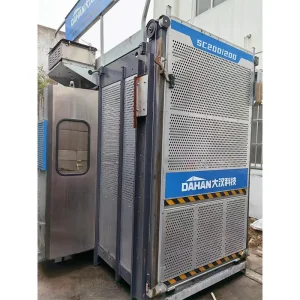
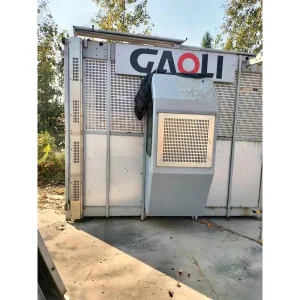
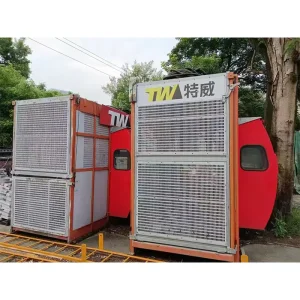
Furthermore, Chinese market leaders like DAHAN, GAOLI, and XCMG adhere to normalized structural dimensioning compatible with international mast interchangeability.
Access certified NDT weld reports, brake torque dissipation certificates, and customs HS code documentation.
Navigating Japanese electrical grids and severe wind-load conditions in coastal Aichi Prefecture.
Central Japan (including Nagoya under the Chubu Electric Power grid) operates on 60 Hz AC transmission at standard 200V commercial operational lines. Machinery exported from standard 50Hz/380V origins undergoes comprehensive rewiring and variable-frequency drive (VFD) recalibration. Our integrated Schneider or Yaskawa control inverters ensure consistent torque curves without motor overheating.
Situated along the Pacific Rim typhoon alley, Nagoya job sites enforce strict tie-in distance engineering. Mast sections exported to this market feature Q345B seamless rectangular manganese alloy steel tubes. Wall-tie anchoring brackets are reinforced to withstand lateral gust pressures reaching up to 60 m/s when parked in typhoon anchor lock-down modes.
Every hoist cage utilizes the SAJ series bidirectional progressive safety arrestor. Prior to container stuffing, our Huai'an inspection yard executes calibrated drop tests using dynamic sensor telemetry. The arrestor smoothly engages within a braking deceleration buffer of 0.15–1.4m/s, preventing structural shock loading on host towers.
Transitioning second-hand export engineering from conventional mechanical upkeep to IoT-integrated, sensor-verified vertical infrastructure.
Every structural weld along standard 650x650x1508mm mast sections undergoes ultrasonic flaw detection (UT) and magnetic particle testing (MT). This mitigates micro-fatigue fractures caused by repeated dynamic cyclic loading, ensuring that refurbished units offer a verified minimum structural service lifespan extending beyond 15 operational years.
To support high-productivity Japanese building methods, our custom export packages offer retrofittable edge-computing micro-controllers. These units monitor brake pad temperature dissipation, gear rack backlash clearance, electrical current anomalies, and cage load eccentricity in real-time, transmitting operational logs directly to site management terminals.
Addressing the pressing skilled-labor shortages confronting the Japanese construction industry (the "2024 problem"), modern hoists are being upgraded with millimeter-accurate laser positioning systems. Cages self-dock smoothly flush to scaffold floor edges, eliminating trip hazards and minimizing loading times for interior dry-walling and precast concrete logistics.
Total end-to-end supply chain oversight prevents field assembly delays, customs friction, and transit rust damage.
A dual-cage SC200/200 unit with 50 meters of mast column, tie-ins, ground enclosures, and electrical cabling demands precise spatial calculation. Mast sections are systematically nested, banded with structural steel straps, and protected with timber dunnage to eliminate maritime rolling impacts. Internal cabin mechanisms and sensitive VFD cabinets are vacuum-sealed with vapor corrosion inhibitors (VCI).
We provide exhaustive documentation packages including manufacturer original birth certificates, historical run-time records, JOM/JIS material cross-reference sheets, certificate of origin (Form R / RCEP where applicable), and third-party inspection dossiers (CCIC, SGS, or Bureau Veritas). This guarantees expedited customs clearance at Nagoya port terminal docks.
Comprehensive listing of late-model tower cranes and rack-and-pinion elevators inspected and staged at our 30+ acre logistics center.
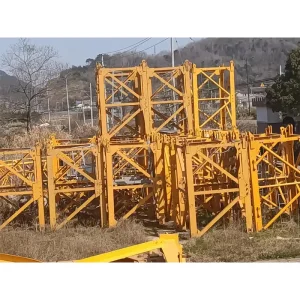
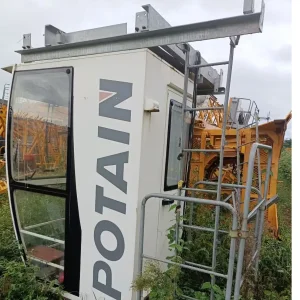
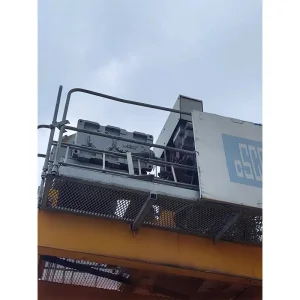
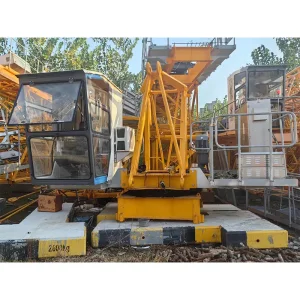
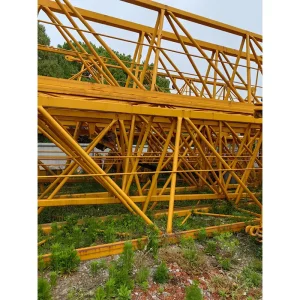
Direct yard inspections, real-time live video checks of mast integrity, and firm CIF Nagoya port quotes delivered within 24 hours.