 YOM 2019-2023
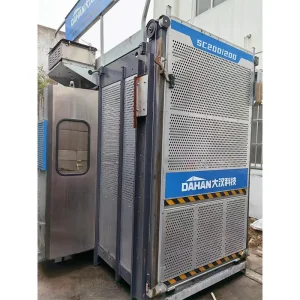
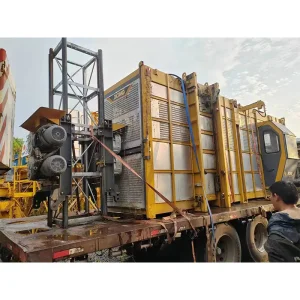
DAHAN SC200/200 High-Speed Construction Hoist (Korea Standard)
- Rated Load: 2 × 2,000 kg
- Lifting Speed: 0 - 46 m/min (VFD)
- Mast Section: 650×650×1508 mm
- Condition: 100% Inspected / Refurbished
Directly sourced from factory fleets, fully tested against KOSHA safety parameters, and equipped with frequency variable drives suitable for South Korean grid power (380V/440V 60Hz).
YOM 2019-2023
 YOM 2019-2023
 YOM 2019-2023
 YOM 2019-2023
The Korean construction and infrastructure market operates under some of the most sophisticated engineering parameters in the Asia-Pacific region. Driven by dense urban redevelopment projects across the Seoul Metropolitan Area (Gyeonggi-do and Incheon), massive semiconductor mega-fab expansions in Pyeongtaek and Yongin, and high-rise commercial structures in Busan Marine City, the demand for ultra-safe, high-efficiency vertical transportation equipment has reached unprecedented levels.
Vertical transport safety in South Korea is heavily governed by strict regulations administered by the Korea Occupational Safety and Health Agency (KOSHA) and local municipal building inspectors. Equipment must satisfy rigorous mechanical stress tests, emergency braking safety margins (such as progressive anti-fall safety devices like SAJ series), and electromagnetic compatibility for variable frequency drives (VFD). Consequently, acquiring pre-owned construction hoists requires far more than simple machinery sourcing—it demands end-to-end technical verification, structural fatigue testing, electrical frequency customization (adapting 50Hz factory settings to 60Hz Korean power grids), and full documentation traceability.
Re-construction projects (Re-건축) in Seoul require compact footprint mast sections, ultra-quiet helical gear drive mechanisms, and high speed (up to 96m/min) to operate smoothly within tight residential proximity.
Industrial giants in Pyeongtaek and Yongin demand heavy payload hoists (up to 3.2 tons per cage) equipped with wide door clearances to transport delicate cleanroom modules, high-voltage transformers, and heavy piping assemblies.
Korean job sites enforce zero-tolerance policies regarding hoist safety. Every imported pre-owned hoist must undergo magnetic particle flaw detection on mast welds and mandatory replacement of critical anti-fall safety devices.
Located in Jiangsu, China, Huaian Zhongqiang International Trade Co., Ltd. operates a massive 30+ acre heavy equipment consolidation yard, offering Korean buyers unmatched logistics speed, strict pre-shipment quality control, and substantial CAPEX savings.
Our staging yards in Jiangsu benefit from immediate maritime access to major East China container and bulk export terminals (Qingdao, Shanghai, and Lianyungang). Vessels arrive at Incheon Port, Pyeongtaek Port, or Busan Port within 48 to 96 hours. This geographical proximity eliminates month-long ocean transits typical of European or American equipment sourcing, ensuring fast project mobilization for time-critical Korean construction schedules.
Unlike brokers who simply trade machinery paperwork, Zhongqiang executes full physical inspections on our 30-acre site. Mast sections are measured for axial deviation, rack gear tooth thickness is checked via digital calipers, electrical panels are re-wired to match South Korea’s 380V/440V 60Hz 3-phase grid system, and fresh anti-corrosion marine epoxy coatings are applied to withstand maritime salt-air transit.
Modern construction hoists have evolved from simple gear-driven cages into intelligent, energy-efficient vertical elevators. Below is an engineering overview of key innovations required by modern job sites.
Variable Frequency Drives (VFD) from Schneider, ABB, or Yaskawa provide soft-start and soft-stop capabilities. This reduces mechanical shock on rack-and-pinion teeth by up to 60%, eliminates current surge spikes on local site generators, and enables smooth floor leveling precision within ±5mm.
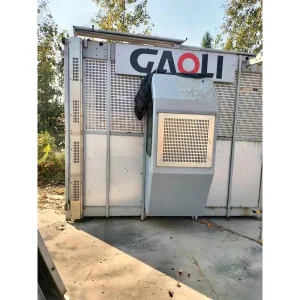
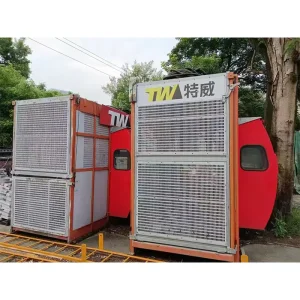
Standardized 650×650×1508mm mast sections manufactured from Q345B high-strength seamless steel tubes allow inter-brand compatibility between leading manufacturers like DAHAN, GAOLI, and XCMG, dramatically lowering fleet spare-part inventory overhead.
Late-model hoists (YOM 2019-2023) integrate real-time sensors monitoring load weights, door lock interlocks, mast inclination, and hoist speed. Data is fed to an integrated operator cabin display with automatic alert triggers to prevent overloading accidents.
Different construction sectors require specialized vertical lifting configurations. Here is how our supplied SC200/200 hoists perform across key Korean engineering scenarios.
In 50 to 70-story residential skyscrapers, twin-cage hoists operating at standard speeds (36 m/min) create bottleneck congestion during morning shifts. We supply upgraded 0-63 m/min and 0-96 m/min ultra-high-speed VFD hoists fitted with auto-landing floor selection systems. Twin independent cages allow simultaneous transport of personnel in one cage and heavy finishing drywall/facade panels in the second cage.
Industrial facility construction requires lifting wide machinery components through exterior wall openings. We configure custom oversized cages (e.g., 3.2m length × 1.5m width × 2.5m height) with reinforced floor plates, side-opening ramp doors, and internal crane davits for effortless material staging directly into upper-level cleanroom floors.
Job sites near sea waters face intense salt mist spray and extreme wind loads. Equipment supplied for these coastal projects feature full hot-dip galvanized mast sections, stainless steel electrical control boxes (IP65 rated), dual-braided marine cable guides, and specialized wind-resistant tie-in collar frames designed to withstand typhoons.
When global and Korean contractors (such as Samsung C&T, Hyundai E&C, DL E&C, and GS E&C) procure pre-owned vertical lifting assets, financial evaluation extends far beyond the initial purchase price.
Purchasing a YOM 2019-2023 certified used SC200/200 hoist reduces asset acquisition costs by up to 60% compared to purchasing brand-new units. This enables machinery rental firms and main contractors to achieve asset payback within 12 to 14 months of site deployment.
By standardizing machinery fleets on proven OEM components (SEW gearboxes, Schneider VFD drive units, and steel rack modules), spare part replacement costs are kept at baseline figures with off-the-shelf availability in South Korea.
High-tier Chinese brand hoists (DAHAN, GAOLI, XCMG) maintain strong international liquidity. After finishing a 3-year project in Korea, equipment can be easily re-inspected and re-exported to emerging markets in Southeast Asia or South America with minimal asset depreciation.
Every unit dispatched from our Huai'an yard includes a complete digital passport: factory original nameplate, year of manufacture certification, non-destructive weld testing reports, anti-fall safety device calibration certificate, and HD operational video.
Browse our full range of certified second-hand machinery available for immediate loading from our Jiangsu yards to Korean destination ports.
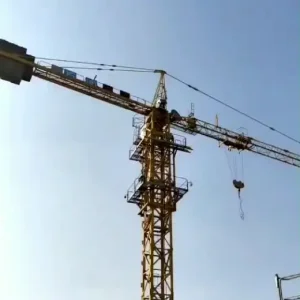 YOM 2013-2014
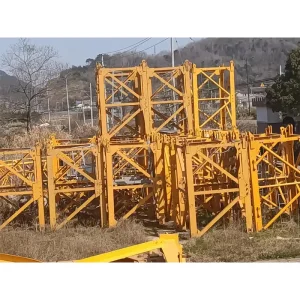 YOM 2019-2023
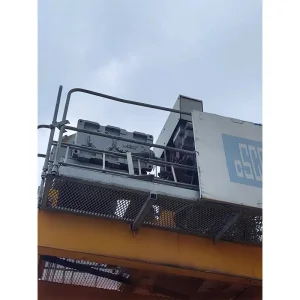 YOM 2019-2023
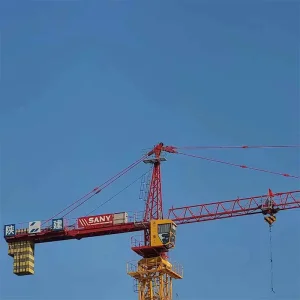 YOM 2019-2023
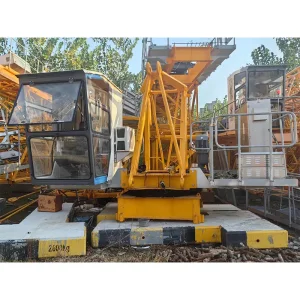 YOM 2019-2023
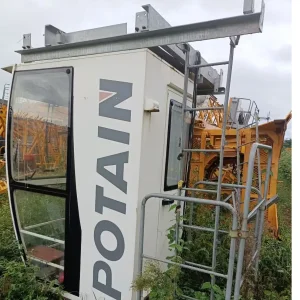 YOM 2018
YOM 2019-2023
Detailed technical answers covering safety regulations, power grid adaptations, pre-shipment inspections, and international sea logistics.
Get in touch with our heavy lifting export specialists today. We provide instant stock catalogs, custom voltage adaptation specs, and competitive CIF port quotes for Incheon, Pyeongtaek, and Busan.