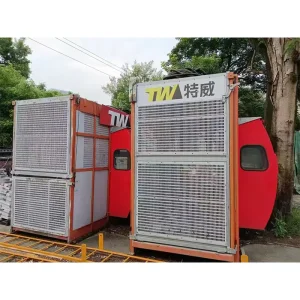
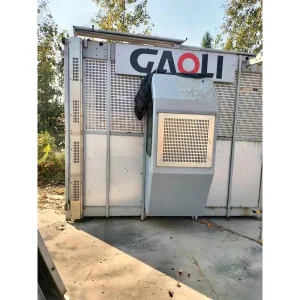
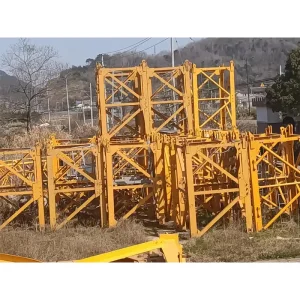
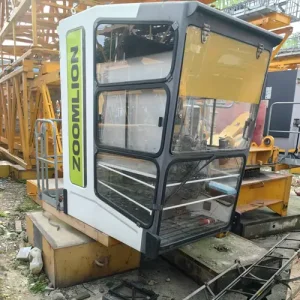
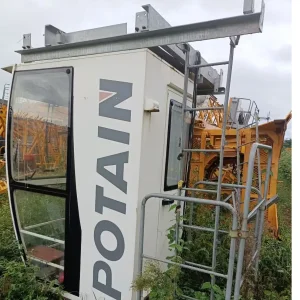
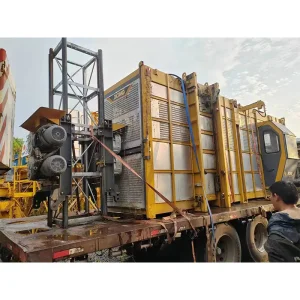
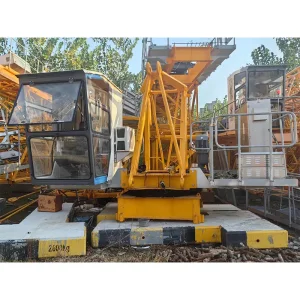
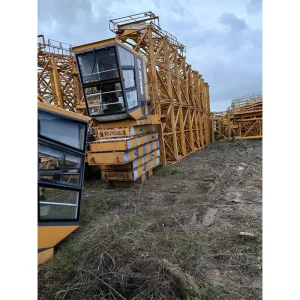
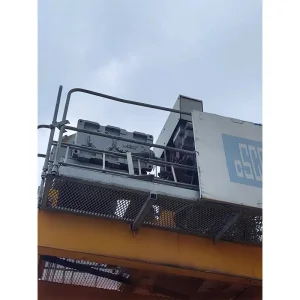
Every machine in our Huai'an yard undergoes 128-point NDT structural weld verification, slewing ring backlash clearance tolerance calibration, and load cell telemetry validation before export certification.
In modern civil infrastructure and modular structural engineering, selecting between a bottom slewing tower crane (self-erecting crane) and a top slewing tower crane dictates project cycle speed, foundation civil costs, and spatial footprint efficiency. As global procurement heads and project directors evaluate wholesale lifting machinery from China, understanding the kinematic advantages of bottom slewing systems unlocks significant operational leverage.
Unlike top slewing cranes where the slewing ring, slewing drive mechanism, and counter-jib swing at the mast top, bottom slewing cranes locate the entire slewing bearing assembly and ballast at ground level. The mast rotates jointly with the jib assembly.
Bottom slewing systems integrate fully automated telescoping and folding kinematics. Telescoping hydraulic cylinders combined with cable-reeving linkages unfold the lattice mast and jib synchronously without secondary mobile assist cranes.
Standard top slewing cranes impose concentrated overturn moments directly into massive cast-in-place concrete foundation slabs requiring deep foundation micro-piling. Bottom slewing systems distribute dynamic loading across broad outrigger pads.
The lifting sector is experiencing a paradigm shift. Advanced variable frequency inverters, embedded CAN-bus telemetry, battery-hybrid power units, and computer-vision collision avoidance redefine wholesale equipment specifications.
Transitioning from high-amperage diesel power packs to 400V 3-phase high-efficiency synchronous permanent magnet electric drives. Integration of LiFePO4 energy storage buffers to manage peak hoisting surges allows operation on constrained 32A site connections.
Equipped with 4G/5G edge industrial gateways, edge-sensor arrays continuously monitor structural strain gauges, hoist gear box vibration spectra, oil dielectric breakdown, and slewing motor thermal metrics.
Integration of ultra-wideband (UWB) hooks and 3D LiDAR scanning provides real-time site obstacle mapping. The control logic automatically enforces dynamic no-go virtual corridors over school zones, railways, or adjacent buildings.
From congested historical city centers to sprawling precast highway infrastructure, matching crane kinematics to specific project archetypes guarantees return on invested capital.
| Sector Application | Operational Pain Point | Bottom Slewing Technical Solution | Economic Advantage / ROI Factor |
|---|---|---|---|
| Urban Infill & Mid-Rise Residential | Extreme street closures, narrow boundaries, overhead power line interference. | Fast setup footprint (4.5m x 4.5m base), integrated folded jib configuration (luffing from 0° to 30° for high-obstacle clearance). | Reduces municipal street permit downtime by up to 80%; eliminates mobile crane assembly congestion. |
| Precast Concrete & Modular Construction | Heavy point loads (4t-8t structural pods), precise centimeter placement accuracy required. | Stepless inverter frequency hoisting (0-60m/min) and bottom slewing low-deflection structural rigidity. | Accelerates precast module cyclic cycle placement times from 25 minutes down to 11 minutes per element. |
| Bridge Abutments & Culvert Civil Works | Rugged terrain, short project durations per segment, remote access without high-voltage grid. | Integrated transport axle bogies; autonomous onboard diesel-generator hybrid running mode. | Avoids permanent foundation abandonment; self-folds for transit to subsequent piers within one shift. |
| Timber-Frame Multi-Story Structures | Fragile mass-timber elements vulnerable to dynamic impact loads during slewing maneuvers. | Dynamic micro-motion slewing control with soft-start eddy current or closed-loop inverter braking. | Prevents edge chipping on cross-laminated timber (CLT) panels; smooth landing with dual-speed inching. |
| Solar Farm & Industrial Roof Installations | Expansive reach required with low hook weight requirements over wide roofs. | Long radius jibs up to 50m with 1.0t - 1.5t tip loads, rapid outrigger hydraulic leveling. | Replaces multiple telehandlers; sweeps complete warehouse rooftop zones from single peripheral staging. |
The global dominance of Chinese lifting machinery manufacturers stems from intense vertical integration, robotic welding automation, ultra-rigorous metallurgical testing, and industrialized component ecosystems.
Mast section chords and diagonal lattice members are welded by multi-axis robotic gantries using high-tensile Q345B and Q460C manganese-alloy structural steel. Full ultrasonic (UT) and magnetic particle inspection (MT) ensures internal weld porosity is completely eliminated.
Every fabricated segment passes through automated multi-nozzle shot-blasting chambers achieving ISO 8501-1 Sa 2.5 cleanliness, followed immediately by electrostatic powder or multi-layer epoxy/polyurethane thermal curing.
The Chinese machinery manufacturing cluster groups planetary gearbox producers, high-frequency quench slewing rings, and ABB/Schneider electric control assemblies within a 100km radius in Jiangsu, Shandong, and Hunan.
Acquiring heavy construction equipment across national borders demands complete alignment with municipal safety standards, lifting directives, and customs import requirements.
Our machines undergo validation against regional standards before departure. We provide the comprehensive engineering documentation required by local occupational safety agencies (OSHA, TÜV, WorkSafe).
Buyers have absolute verification rights before loading. Huaian Zhongqiang invites buyer personnel, independent inspectors, or provides digital remote audits.
Dismantling high-value tower cranes and bottom slewing chassis requires professional rigging, protective packaging, and load lashing engineering to avoid transit deformation.
When major EPC contractors, crane rental fleets, and mining engineering consortiums source wholesale bottom slewing cranes, capital expenditure (CapEx) represents only one portion of the lifecycle cost calculation.
Late-model inspected units (YOM 2018–2023) from industry leaders provide 85–90% of the operational life of a brand-new crane at approximately 45–55% of the capital outlay. This accelerates asset amortization and optimizes balance sheet liquidity for rapid fleet scaling.
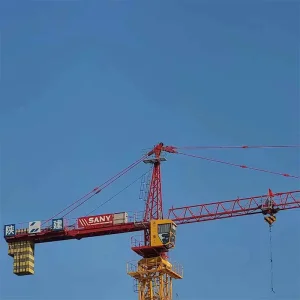
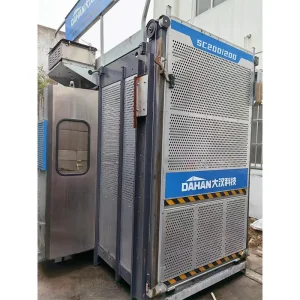
Wholesale buyers must evaluate spare part availability. By concentrating on market-leading platforms (Zoomlion QTZ, Potain MC, Sany, Dahan), contractors safeguard cross-compatibility of hoisting ropes, trolley blocks, limit switches, and PLC cards across multiple projects.
Tier-1 Chinese manufactured tower cranes and Potain joint-venture cranes retain strong secondary market valuation throughout Southeast Asia, Africa, Latin America, and Eastern Europe, ensuring steady residual values upon project completion.
Select from our audited warehouse inventory in Huai'an, Jiangsu. Full factory nameplates, pre-shipment videos, and customs clearances are supplied with each machine.
Detailed technical, operational, and commercial answers regarding used crane certification, bottom slewing kinematics, pre-shipment inspections, and international ocean logistics.
On a bottom slewing crane (commonly known as a self-erecting crane), the slewing ring, slewing drive mechanism, and counterweights are located on the ground undercarriage platform. The entire mast, jib, and machinery deck rotate together. On a top slewing crane, the mast is fixed to the foundation, and only the jib, counter-jib, and slewing tower head rotate at the top of the mast. Bottom slewing designs allow for self-erection via hydraulic cylinders, simpler ground maintenance, and require less complex foundation engineering.
YOM stands for Year of Manufacture. Our inventory primarily covers YOM 2018 through 2023. We verify each unit's age using original OEM rivet-stamped metal nameplates, manufacturer chassis embossings, matching serial numbers on major mast chord sections, and original factory equipment passport logbooks issued by manufacturers like Zoomlion, SANY, XCMG, and Potain.
Our quality inspection includes: 1) Ultrasonic testing (UT) and magnetic particle inspection (MT) of mast, jib, and tie-bar welds for fatigue cracks; 2) Slewing bearing radial and axial play measurement using dial indicators; 3) Hoist, trolley, and slewing planetary gear oil analysis for metallic particulate wear; 4) Brake torque testing and lining thickness measurement; 5) Wire rope core integrity checks; 6) Verification of load moment limiters, maximum load cut-offs, and anemometers; and 7) Megger insulation resistance testing of the complete 380V/440V electrical control circuit.
Depending on dimensions, cranes are packaged for multi-modal shipping: Self-erecting cranes and compact bottom slewers are secured on dedicated transport chassis or loaded onto 40ft Flat Racks (FR) with calibrated center-of-gravity lashing. Standard tower cranes are dismantled into individual mast sections, jib bundles, cab capsules, counter-jib segments, and winch packages, and containerized into 40ft High Cube (HQ) dry vans. Critical electronics, wire rope drums, and hydraulic control manifolds are treated with corrosion inhibitors and vapor corrosion inhibitor (VCI) heat-shrink wrap.
Huaian Zhongqiang holds independent Chinese import and export operating rights. We supply: Clean on-board Ocean Bill of Lading (B/L), Commercial Invoice, Detailed Packing List with piece weights and dimensions, Certificate of Origin (Form A, Form E, or RCEP where applicable), OEM Structural Steel Material Mill Test Certificates (MTC), Non-Asbestos Declarations, and Third-Party Pre-Shipment Inspection Reports (e.g., CCIC, SGS). Machines bound for the EU are verified against CE Machinery Directive compliance documents.
Yes. We welcome international buyers to our 30+ acre facility in Huai'an, Jiangsu Province. Our staff assists with formal visa invitation letters, transport from Shanghai Hongqiao (SHA) or Huai'an Lianshui Airport (HIA), and provides full yard access to operate machinery under powered test loads. Alternatively, buyers can appoint third-party inspection firms (e.g., SGS, Bureau Veritas) or request an interactive 4K video inspection covering the chassis, motor insulation resistance, and limit switch functionality.