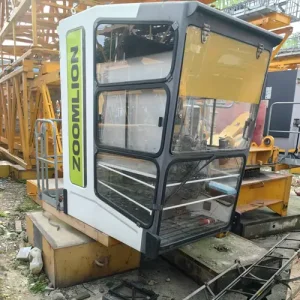
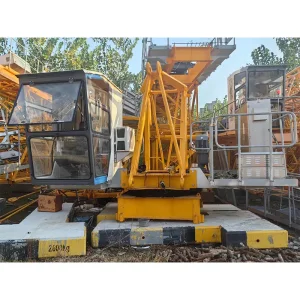
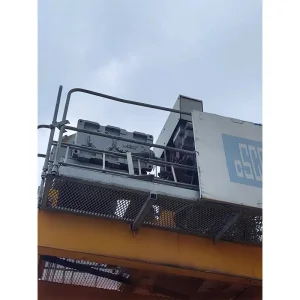
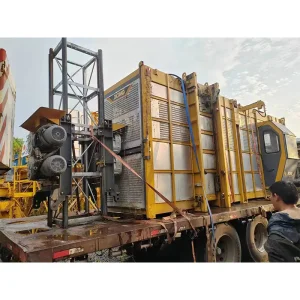
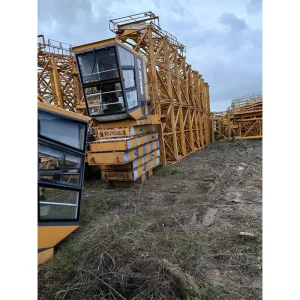
Pre-tested OEM inventory originating from premium production lines with full structural integrity verification, non-destructive weld testing, and guaranteed performance metrics.
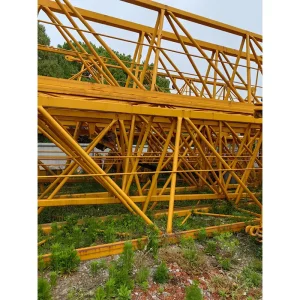
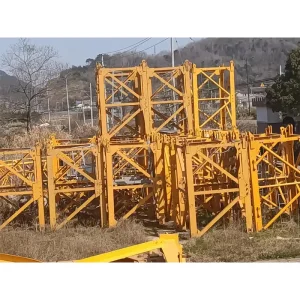
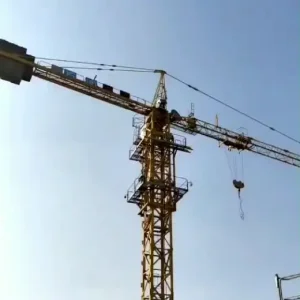
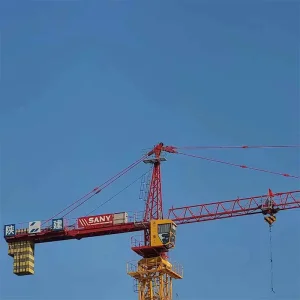
A comprehensive examination of why cat-head tower structures dominate high-capacity vertical logistics through optimized tensile load transfer and cantilever distribution.
The hallmark of the A-Frame tower crane is its vertical apex tower head. By anchoring high-tensile tie rods from the A-frame crown to specific nodes along the jib and counter-jib, bending moments on the main chord members are converted primarily into pure axial compression, allowing unprecedented structural stability.
Compared to topless (flat-top) models where the jib must act as an uninterrupted heavy cantilever beam, A-frame tie rods absorb tremendous uplift and droop tensions. This allows our partner factories to engineer lighter jib structures that achieve greater reaches (up to 75m) without overloading the slewing ring or chassis.
The open-lattice design of both the cat-head and tie-supported jib diminishes lateral aerodynamic resistance. In coastal and typhoon-prone industrial corridors, A-frame cranes deliver superior survivability under out-of-service freewheeling conditions, keeping torsional stresses well within FEM 1.001 design code boundaries.
| Structural Parameter | A-Frame (Cat-Head Topkit) | Flat-Top (Topless) Crane | Engineering Benefit |
|---|---|---|---|
| Primary Stress Mode | Axial Compression + Tie Tension | Pure Cantilever Bending Moment | Higher tip-load capacity at extended radiuses |
| Jib Section Weight | 15% – 25% Lighter profile | Significantly heavier steel chording | Reduced deadweight load on slewing bearing |
| Wind Drag Coefficient ($C_w$) | Low lateral wind impedance | Moderate to high profile resistance | Enhanced stability in coastal/high-altitude zones |
| Overlapping Clearances | Requires staggered working heights | Compact vertical air-rights clearance | Dedicated heavy lifts on standalone civil sectors |
Unmatched raw material availability, automated robotic welding, and national grade qualifications power our 30+ acre logistics hub in Huai'an, Jiangsu.
Our partner factories manufacture mast sections using certified Q345B and Q460C low-alloy structural steels sourced directly from domestic steel conglomerates. These high-yield strength alloys preserve structural elasticity and resist brittle cracking under severe Arctic or equatorial operating temperatures.
From seamless plasma cutting to robotic submerged arc welding and multi-axis boring machines for fishplate pin-holes, Chinese crane manufacturing integrates tight dimensional tolerances. This ensures 100% interchangeable pin connections and effortless climbing telescoping on job sites worldwide.
Huaian Zhongqiang operates backed by a Chinese National Level-2 construction machinery qualification. In our 30+ acre facility, each unit undergoes strict load deflection analyses, ultrasonic weld testing, and hydraulic pressure decay evaluations before entering export crating.
Overcoming jurisdictional engineering hurdles: how our factory engineering packages fulfill North American, European, and regional statutory lifting mandates.
European imports demand strict compliance with EN 14439 wind out-of-service parameters and safety circuit redundancies. We supply cranes re-calibrated with variable frequency drives (VFD), dual mechanical limit switches, and complete acoustic warning sensors certified to European CE benchmarks.
For US and Canadian general contractors, documentation is crucial. Zhongqiang delivers factory stamped load-moment indicator (LMI) calibration files, metallurgical certs for fishplate steel, wire rope non-spin break tests, and English operation manuals compliant with OSHA § 1926 subpart CC.
Export units shipping to the Middle East, Southeast Asia, or Latin America feature upgraded IP55/IP65 electrical cabinets, tropicalized internal copper motor windings, integrated heavy-duty cab HVAC systems, and marine-grade epoxy polyurethane anti-corrosion finishes.
From precast modular megastructures to smart telematics: where A-Frame tower cranes prove irreplaceable and how digital telemetry is shifting operations.
Modern building requires hoisting precast concrete walls, bathroom pods, and modular steel pods weighing between 6 and 16 tons. A-frame cranes deliver the heavy lifting curves at mid-to-far radius required to land modular assemblies precisely without chord flexion.
Suspension bridge pylons and dam construction present severe vertical heights and fluctuating ravine wind shears. The rigid topkit configuration allows internal climbing systems to reach freestanding heights exceeding 250 meters while preserving structural stiffness.
Late-model A-frame cranes supplied by Zhongqiang integrate digital safety black-boxes, real-time wireless anemometers, anti-collision zoning algorithms, and high-definition hook cameras feeding 4K video feeds directly to the ergonomic operator chair.
Authoritative answers addressing engineering verification, logistics breakdowns, customs clearance, and spare parts availability from our export directors.
Explore additional verified lifting machinery ready for containerization, export clearance, and immediate jobsite deployment worldwide.