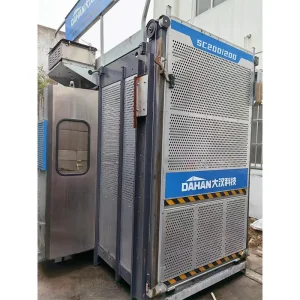
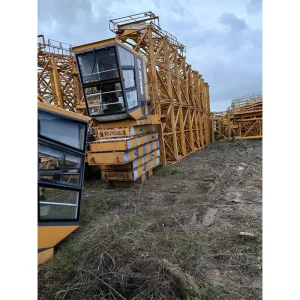
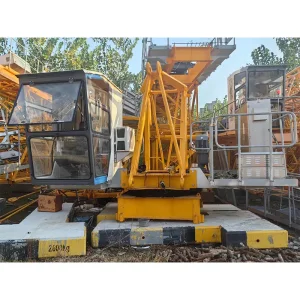
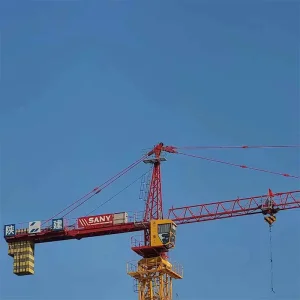
Inspected, tested, and pre-configured lifting equipment ready for export from our Huai'an yard.
An analysis of macro-economic capital efficiency, residual asset value retention, and global demand shifts toward certified pre-owned lifting machinery.
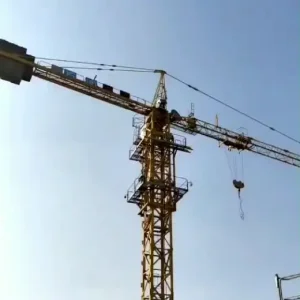
The global construction equipment ecosystem has undergone a structural transformation over the past decade. Rapid urban development across Southeast Asia, the Middle East, Latin America, and Africa—combined with infrastructure renewal projects in North America and Western Europe—has created an unprecedented demand for high-capacity, heavy-duty lifting machinery. Among premium European OEMs, Liebherr tower cranes (specifically the HC-L luffing jib series, EC-H top-slewing series, and High-Flyer modular designs) represent the benchmark for structural longevity, precision slewing control, and load-moment engineering.
However, supply chain disruptions and extended lead times for new OEM equipment—often stretching from 12 to 18 months—have compelled EPC contractors, rental fleet managers, and infrastructure developers to turn to the global secondary market. A certified pre-owned Liebherr crane, or a premium Chinese Tier-1 counterpart (such as Zoomlion, XCMG, SANY, or Potain manufactured in China), offers up to 40% to 60% capital expenditure savings while delivering operational efficiency identical to new machinery when sourced through audited industrial refitters.
How Chinese engineering hubs deliver unmatched quality control, technical re-engineering, and cost-effective turnaround for global buyers.
Every used crane chassis, mast section, and jib tie-rod undergoes Non-Destructive Testing (NDT) including Ultrasonic Flaw Detection and Magnetic Particle Testing to identify micro-fractures prior to export clearance.
Mechanical components are not merely repainted. Slewing bearings are measured for backlash tolerance (<0.8mm), planetary gearboxes flushed/rebuilt, and electrical systems upgraded with Schneider/ABB VFD drives.
Operating out of a 30+ acre warehouse and testing yard in Huai'an, Jiangsu, Huaian Zhongqiang maintains immediate stock across multiple YOM brackets (2018–2023) with direct port connections to Shanghai and Qingdao.
China has established itself as the global capital for heavy machinery recycling and technical re-engineering. By leveraging industrial ecosystems in Jiangsu, Shandong, and Hunan, Chinese suppliers can source genuine Liebherr, Potain, and native Tier-1 crane components at a fraction of Western service costs. This localized manufacturing density allows factories to execute complete teardowns, sandblasting to Sa 2.5 anti-corrosion standards, structural recoating with polyurethane marine-grade enamel, and load-limiter recalibration within a 10-to-15-day factory cycle time.
Where and how global enterprises deploy used Liebherr and Chinese topkit/flat-top tower cranes for maximum operational efficiency.
In congested urban centers across the Middle East (Dubai, Riyadh) and Southeast Asia (Bangkok, Jakarta), flat-top cranes (such as Yongmao STT series and Potain MC series) and Liebherr HC-L luffing cranes are mandatory. Luffing jibs prevent interference with neighboring airspace while handling heavy steel framework erection up to 300+ meters in height.
For heavy civil projects involving cable-stayed bridge pylons and dam construction, high load-moment capacity cranes (250 t·m to 500 t·m class like Zoomlion QTZ250 or Liebherr EC-H 280) are essential. They provide rigid structural stability, high wind resistance rating (up to 20m/s operating wind limit), and fine-positioning micro-speed hoisting capabilities.
Thermal, nuclear, and wind energy installations demand heavy component lifting (12t to 25t single-hook load capacity). Pre-owned heavy-duty cranes offer power developers an economical route to erect cooling towers and boiler houses without tying up vast operational liquidity.
The modern shift toward Prefabricated Prefinished Volumetric Construction (PPVC) requires high tip load capacities at maximum radius. Used 10t–16t class cranes provide the exact torque and tip capacity needed to place 3-ton precast concrete pods at 60-meter working radii.
How telematics, green electrification, and modular standardization are redefining used crane procurement.
Modern retrofitting involves installing universal IoT monitoring systems on older tower crane models. Real-time load-moment indicators (LMI), wind speed logging, anti-collision sensors, and remote diagnostics are now routinely integrated into YOM 2018–2023 units, giving site managers full digital fleet visibility.
Replacing traditional slip-ring motors with full Variable Frequency Drive (VFD) inverter controls reduces power consumption by up to 30%, eliminates high starting current surges on job-site generators, and ensures ultra-smooth micro-positioning of heavy loads.
Standardization of mast section pin connections (e.g., L46, L68, or Liebherr 120 HC / 256 HC lattice formats) allows global operators to mix and match mast inventory, reducing total freight costs and maximizing cross-fleet component utilization.
Essential decision criteria for purchasing managers, machinery importers, and fleet controllers.
When evaluating pre-owned lifting equipment from China, international buyers must analyze four critical cost centers beyond the initial FOB purchase price:
In-depth technical and logistical answers for engineering procurement teams.
Browse our complete range of tested lifting equipment ready for ocean transport.
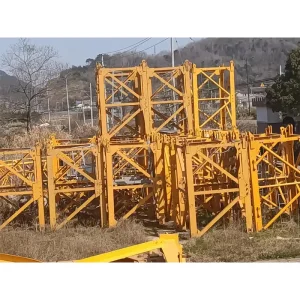
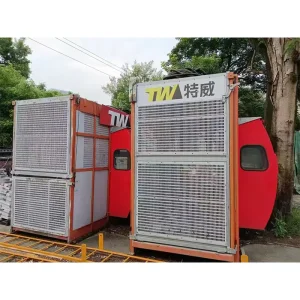
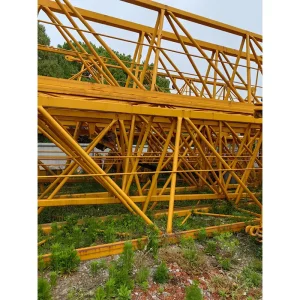
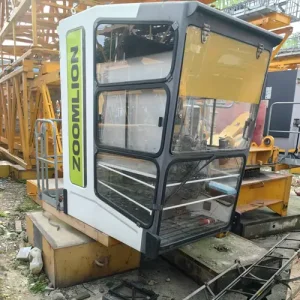
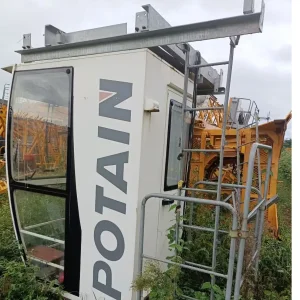
Operating a 30+ acre machinery yard in Huai'an, Jiangsu, China. We specialize in audited pre-owned tower cranes, construction hoists, and heavy lifting export logistics worldwide.
Yard Address: West Side of Wenzhou Industrial Park, Qianjiang Road, Huaiyin District, Huai'an, Jiangsu, China
Office Address: No. 1 R&D Building, Jianghuai Science and Technology Park, Huai'an, Jiangsu, China
Qualifications: National Level-2 Construction Machinery Export Operator