Engineering benchmarks, global sourcing dynamics, and certified fleet procurement: How Chinese smart manufacturing and rigorous pre-shipment diagnostics deliver zero-downtime hoisting operations for high-rise developments worldwide.
Selected topkit, flat-top tower cranes and dual-cage vertical construction hoists factory-inspected for immediate deployment on high-density metropolitan job sites.
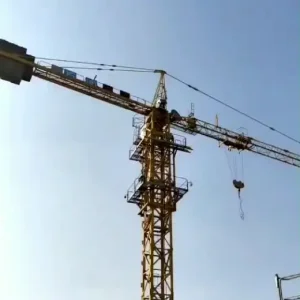
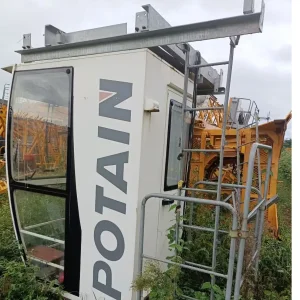
Urban densification, modular precast construction (PPVC), and super-tall structural demands have reshaped crane load dynamics from conventional static lifting to synchronized micro-motion lifting arrays.
Modern skyscrapers exceeding 200–500 meters have shifted structural construction toward heavier steel core tubes and composite mega-columns. Traditional 6-ton capacity units are increasingly replaced by 12-ton, 16-ton, and 25-ton self-climbing workhorses to handle massive precast slabs and heavy façade units without structural deflection.
Precision positioning at heights over 300 meters is exposed to severe vortex shedding and high-altitude wind gusts. The deployment of closed-loop vector-controlled hoisting and slewing in modern Chinese tower cranes enables millimeter-precision millimeter landing speeds (sub-5 mm/sec), ensuring zero shock loading during precast connection.
Tight urban plots in cities like Singapore, Seoul, Frankfurt, and New York make external foundation anchoring cost-prohibitive. Internal floor-climbing systems save up to 70% in mast steel costs by climbing within elevator shafts, creating immense global demand for adaptable, compact hydraulic climbing collars.
Procuring a brand-new 12-ton European hammerhead crane typically requires $450,000–$750,000 with lead times stretching beyond 30 to 45 weeks. Conversely, sourcing an authenticated, low-hour Chinese late-model crane (YOM 2018–2023) from top-tier OEMs (Zoomlion, XCMG, Potain China, SANY) reduces upfront capital expenditure by 45–60% while matching exact structural safety parameters, backed by abundant spare-part ecosystems worldwide.
From state-of-the-art intelligent manufacturing clusters in Jiangsu, Hunan, and Shandong to rigorous metallurgical processing, Chinese crane manufacturers have established unparalleled production efficiency.
OEM facilities (such as Zoomlion's Intelligent Crane City and XCMG heavy plants) utilize 100% automated multi-axis robotic welding lines for standard mast sections (e.g., L68, L46, and mast frames), achieving sub-millimeter weld bead consistency and eliminating heat-affected zone structural brittleness.
China concentrates over 80% of the world’s slewing bearings, planetary reducers, high-tensile anchor bolts, and specialized marine-grade enamel coating systems within a 300-kilometer industrial corridor. This cluster dynamics yields shorter replenishment lead times and lower maintenance costs.
Chinese national lifting equipment codes (GB/T 5031, GB 5144) incorporate safety factors on fatigue life, wind load resistance, and dynamic over-moment tests that mirror or exceed EN 14439 (European) and FEM 1.001 standards, assuring seamless integration with international safety protocols.
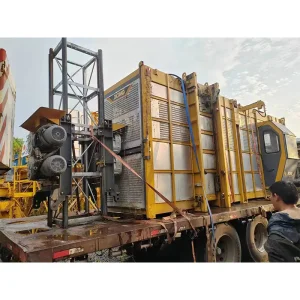
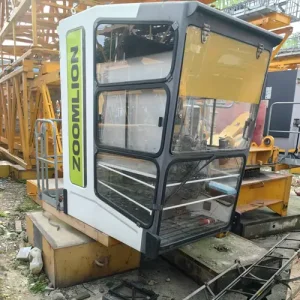
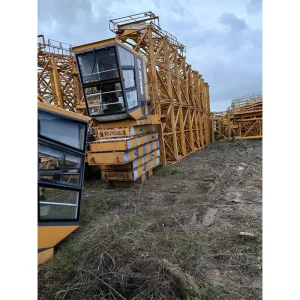
Factory yards are engineered for precision modular knock-down dismantling. Jib sections, counter-jibs, operator cabins, and hoisting drums are engineered to nest cleanly into standard 40-foot High Cube (40HC) and Flat Rack containers, reducing dead ocean freight space by up to 28%.
A comparative technical matrix matching superstructure structural typologies with crane classifications, climbing configurations, and key working envelopes.
| Building Typology | Recommended Crane Architecture | Typical Working Radius / Tip Capacity | Climbing System | Critical Engineering Considerations |
|---|---|---|---|---|
| Commercial Mega-Talls (300m - 500m+) | Heavy Hammerhead / Luffing Jib (e.g., Zoomlion 7025-12, Potain MC320) | 50m – 70m / 2.5t – 3.2t @ tip (Max: 12t - 16t) | Internal Floor Climbing inside reinforced concrete elevator core | High-capacity rope drum spooling (up to 800m rope layer), active anti-twist ropes, wind anemometer auto-weathervaning. |
| High-Density Residential Towers (100m - 200m) | Flat-Top / Topless (e.g., SANY QTZ100 6013-6, DAHAN QTZ100) | 60m / 1.3t @ tip (Max: 6t - 8t) | External Mast Tied (Wall Anchors every 6-8 floors) | Allows close-proximity overlap with adjacent cranes (no tower-head collision risks), fast erection and dismantling via mobile crane. |
| Prefabricated Prefinished Volumetric (PPVC) Projects | Ultra-Heavy Duty Flat-Top / Heavy Hammerhead | 55m – 65m / 3.5t – 5.0t @ tip (Max: 16t - 25t) | Rigid High-Section Mast (L68B / L69) with embedded foundation anchors | Rigid mast design minimizes jib sag when lifting integrated finished volumetric bathroom and room units weighing 10-18 metric tons. |
| Metropolitan Infill Sites & Airspace Restrictions | Luffing Jib Crane or Compact Flat-Top | 35m – 50m / 2.0t @ tip (Max: 8t - 10t) | Self-Climbing inside shaft or slim-profile external anchoring | Luffing mechanisms stay within strictly bounded property lines, preventing encroachment into adjacent airspace or aviation limits. |
High-rise ties must transfer torsional and horizontal wind loads to structural floor slabs without exceeding slab punch-shear capacity. Factory-engineered three-point and four-point struts accommodate variable slab thicknesses and exterior cantilever overhangs.
Lifting concrete buckets or rebar bundles 250+ meters requires high-speed VFD motors (55 kW – 90 kW). Overcoming voltage drops across long vertical cable runs necessitates specialized heavy-gauge copper drop cables and auto-tensioning cable reels.
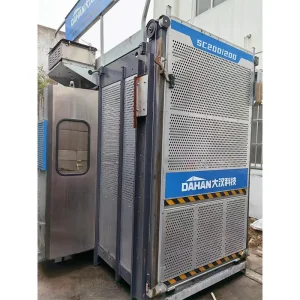
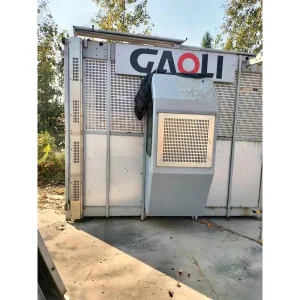
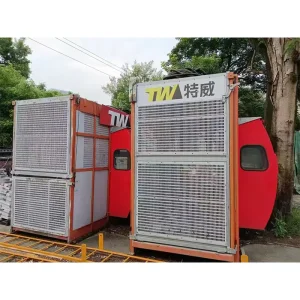
High-rise efficiency requires pairing tower cranes with dual-cage vertical personnel/material hoists (e.g., SC200/200). Relieving tower cranes of light vertical cargo lets the crane concentrate on critical structural paths, raising site productivity by 35%.
Operating from our 30+ acre logistics and refurbishment center in Huai'an, Jiangsu, our certified engineers and loading crews subject each unit to rigorous physical inspection and electrical verification before export.
Every mast chord, jib pinned joint, fishplate, and climbing sleeve undergoes Ultrasonic Flaw Detection (UT) and Magnetic Particle Testing (MT) to ensure the steel is free of hidden micro-fractures, weld fatigue, or residual stresses.
Our head office holds a Chinese National Level-2 qualification alongside independent customs-registered export rights. Overseas buyers contract directly with an asset-holding enterprise, avoiding intermediary surcharges and commission markups.
Located close to major East China ports (Shanghai, Taicang, Qingdao), our in-house rigging crews oversee professional container stuffing, counter-jib lashing, and heavy steel component securing to prevent salt spray corrosion and transit damage.
Leading Chinese OEMs are incorporating digital diagnostics, teleoperation, and low-carbon powertrains into crane designs, setting new benchmarks for high-altitude lifting safety and site efficiency.
Operator climb times on 300-meter towers can exceed 45 minutes each way. Emerging 5G teleoperation suites relocate operators to climate-controlled ground operations centers, using low-latency multi-camera visual feeds and sensory feedback systems to enhance ergonomics and precision control.
Sensor-fusion hook tracking cameras and lidar arrays map live 3D site geometry in real time. Systems automatically enforce "no-fly" zones above public roads, schools, or adjacent high-voltage lines, cutting cross-boom collision hazards in dense urban clusters.
Lowering 10-ton loads from heights of 400 meters generates substantial potential mechanical energy. Next-generation hoist winches channel regenerative power back to on-site battery storage arrays or the site grid, shaving peak kilowatt-hour energy demand by up to 25%.
A structured procurement roadmap for EPC procurement heads, equipment asset managers, and project directors seeking to minimize risk and confirm operational readiness before issue of Letter of Credit.
Verify that original stamped manufacturer nameplates match the crane chassis number, base mast certificate, and export dossier. Late-model units (2018–2023) ensure at least 15–20 years of residual fatigue design life under normal duty cycles.
Dial indicator verification of slewing ring bearing raceway clearance (axial and radial runout) ensures readings stay well within OEM tolerances (< 0.25mm - 0.35mm), preventing gear backlash and excessive mast top sway during braking.
Insist on live dynamic load-testing documentation covering the Load Moment Indicator (LMI), maximum hoist weight cut-off switches, trolley travel buffers, slewing limit sensors, and cable drop fail-safe catches.
We welcome third-party inspections (SGS, TÜV, BV, or buyer-appointed technical representatives) at our Huai'an yard, accompanied by uninterrupted 4K video live streams verifying machine startup and dry cycling.
Technical, contractual, and logistics answers for procurement executives sourcing tower cranes from China for high-rise building projects.
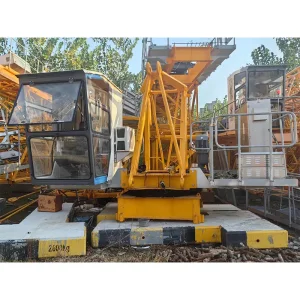
A: Topkit (hammerhead) cranes utilize a tower head (cat-head) and tie-rods to support the jib, providing excellent structural rigidity and lighter overall jib weight across longer reaches (60m–75m). Flat-top (topless) cranes eliminate the tower top and tie-rods. While this requires slightly heavier jib sections, it allows simple, safe erection by sections and permits close vertical overlap on sites where multiple cranes swing over one another without risking jib-to-tie rod collision.
A: There are two primary climbing methodologies: External Climbing, where the crane mast sits outside the building perimeter on a concrete pad, adding mast sections via a hydraulic climbing cage and securing tie-in collar frames to the building every 30 to 50 meters. Internal Floor Climbing positions the mast inside an elevator core or floor opening; hydraulic cylinders push against climbing beams pinned to structural floors, raising the crane upwards every 3 to 4 storeys without needing extra mast sections.
A: QTZ is the Chinese national standard designation (Q=QiZhongJi / Crane, T=TaShi / Tower Type, Z=ZiShengShi / Self-Erecting or Self-Climbing). The number following (e.g., QTZ100, QTZ250) represents nominal rated load moment in metric ton-meters (t·m). Secondary numbers like "7025-12" indicate a 70m maximum reach, 2.5-ton tip load at 70 meters, and a 12-ton maximum hoist capacity.
A: At our 30+ acre yard in Huai'an, every unit undergoes wire brushing, rust-inhibiting primer touch-ups, and protective oil wraps on machined pin bores, slew teeth, and rope sheaves. Sensitive electronics, VFD cabinets, and operator consoles are sealed in desiccant-packed multi-layer moisture barrier foils before being strapped and blocked inside standard shipping containers or flat racks.
A: Huaian Zhongqiang issues standard commercial invoices, detailed itemized packing lists, negotiable ocean bills of lading, and official Certificates of Origin (CO / Form E / Form A). Additionally, we provide comprehensive NDT inspection reports, original manufacturer factory certificates, operating load charts, and electrical schematics to support destination-country safety licensing and third-party engineer commissioning.
Explore our verified machinery ready for worldwide deployment. Every unit includes stamped OEM nameplates, tested electricals, and full logistics coordination.