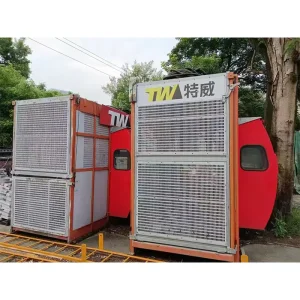
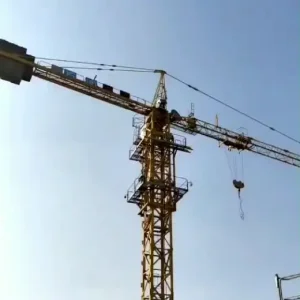
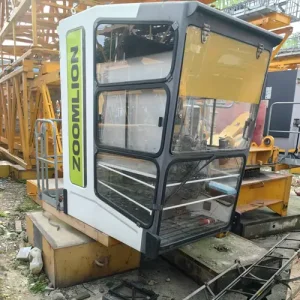
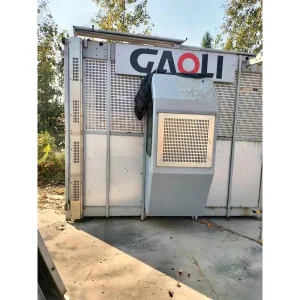
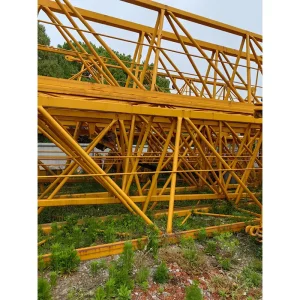
Fully audited, load-tested, and factory-inspected self-building tower cranes and rack-and-pinion builder hoists from China's primary equipment staging yards.
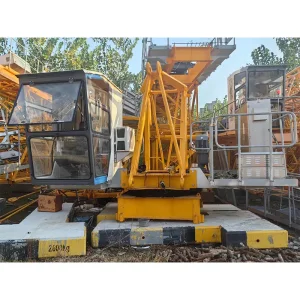
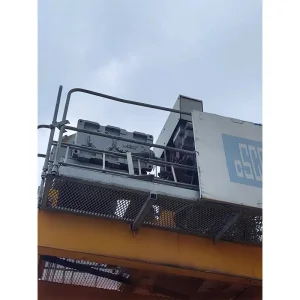
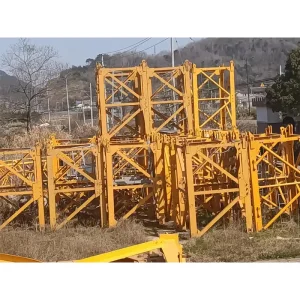
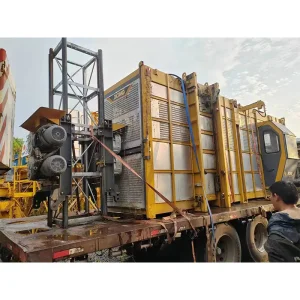
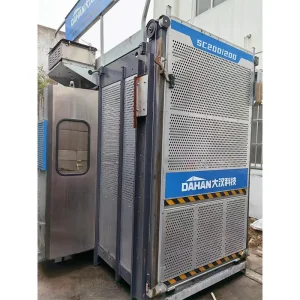
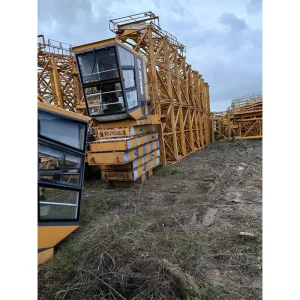
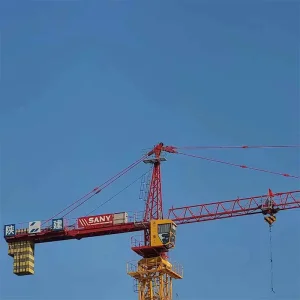
In modern mega-scale structural construction, vertical elevation speed and crane reconfiguration autonomy define critical path efficiency. Discover the mechanical thermodynamics, hydraulic sequencing, and torque safety controls of Chinese engineering platforms.
Self-building tower cranes (also referred to as self-raising, self-climbing, or telescoping cranes) rely on an external climbing collar equipped with heavy-duty hydraulic rams. The telescoping cage encircles the mast tower, utilizing high-pressure hydraulic cylinders (operating at 25–31.5 MPa) to lift the entire upper assembly—including slewing table, operator cabin, counter-jib, and main working jib. Once extended, a temporary opening is cleared to hoist and pin a standard mast section into place without external mobile crane assistance.
Chinese manufacturers excel in both external tied-in climbing systems and internal climbing floor systems. External climbing utilizes reinforced structural steel wall tie-ins (anchorage collars) secured into core concrete shear walls, enabling working heights surpassing 300 meters. Conversely, internal climbing designs fit within elevator lift shafts, climbing on specialized hydraulic floor wedges (climbing ladders) to eliminate the requirement for hundreds of meters of standalone mast sections, dramatically reducing project CapEx.
Precision during the telescoping stroke demands rigorous balance. The crane's trolley must be placed at a calibrated equilibrium radius with a designated counter-weight or balancing ballast to zero out bending moments on the climbing mast guide rollers. High-precision load moment sensors (LMI) interconnected with PLC control units verify zero deflection before hydraulic jacking pressures can be applied, safeguarding structural integrity against wind gusts or eccentric loading.
| Model Series | Structural Typology | Max Capacity / Tip Load | Free-Standing Height | Max Jacked Height (Tied) | Hydraulic Jacking Cylinder Spec |
|---|---|---|---|---|---|
| QTZ100 (6013-6) | Topkit / Hammerhead Self-Erecting | 6.0 t / 1.3 t @ 60m | 40.0 m | 150.0 m – 180.0 m | D160/d110 stroke 1450mm, 25 MPa |
| QTZ200 (7020-12) | Topkit / Hammerhead High-Torque | 12.0 t / 2.0 t @ 70m | 50.0 m | 200.0 m – 220.0 m | D180/d125 stroke 1650mm, 28 MPa |
| QTZ250 (7025-12) | Heavy-Duty Prefab Modular Lift | 12.0 t / 2.5 t @ 70m | 60.0 m | 220.0 m – 260.0 m | D200/d140 stroke 1650mm, 31.5 MPa |
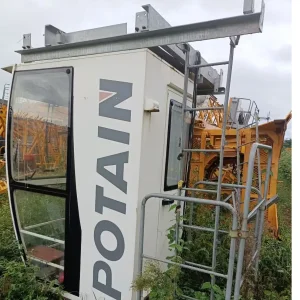
| POTAIN MC320-12 | Topkit Slewing Tower (2.0m Mast) | 12.0 t / 3.2 t @ 70m | 52.7 m | 240.0 m+ | Telescopic cage system with guided roller lock |
| YONGMAO STT153 | Flat-Top (Topless) Self-Building | 10.0 t / 1.5 t @ 70m | 45.0 m | 200.0 m | Integrated quick-pin climbing cage |
Macro infrastructure investments across Southeast Asia, the Middle East, Latin America, and Eastern Europe are precipitating an urgent transition from outdated, low-capacity cranes toward engineered, late-model (YOM 2018–2023) high-efficiency lifting solutions.
Rapid adoption of Prefabricated Prefinished Volumetric Construction (PPVC) has shifted lifting requirements from conventional 3-ton tip capacities to heavy-load envelopes demanding 8 to 12-ton peak loads and tip lifts exceeding 2.5 tons at 70 meters.
Metropolitan zones in Seoul, Singapore, Manila, and Dubai leave zero perimeter clearance for massive lattice-boom crawler cranes. Self-building tower cranes anchor into the concrete foundation mat, growing vertically alongside the skyscraper.
Global EPC contractors face soaring inflation. Sourcing verified late-model (YOM 2018–2023) cranes from China's primary staging bases reduces capital expenditure by 45%–60% compared to new European units while maintaining identical load-moment yields.
Global lead times for newly forged European tower cranes can exceed 9 to 14 months. China's deep secondary asset reserves enable dispatch-ready deployment within 7–14 days of contractual execution, slashing commercial gestation timelines.
How Huaian Zhongqiang International Trade Co., Ltd. coordinates massive logistics yards, strict non-destructive testing (NDT), and unmediated export channels for global buyers.
Operating out of Huai'an, Jiangsu Province—at the direct epicenter of China's heavy industrial manufacturing corridor—our warehouse yard hosts over 30 contiguous acres dedicated exclusively to structural staging, electrical testing, and mechanical pre-commissioning.
Our headquarters retains an authentic Chinese National Second-Level Qualification for construction machinery engineering. Unlike opportunistic brokers, we hold independent, direct import and export legal rights, guaranteeing zero intermediaries, direct bank-to-bank transactions, and verified provenance.
Positioned with rapid access to the deep-water ports of Shanghai, Lianyungang, and Taicang, our in-house rigging crews dismantle, color-code, rust-proof, and pack complete tower cranes into standardized 40ft Open Top, High Cube, or Flat Rack containers, backed by certified sea-lashing protocols.
From coastal typhoon corridors to deep inland seismic regions, self-building tower cranes must be deployed according to localized geotechnical, structural, and climatic parameters.
Deployed in concrete vertical building cores exceeding 200 meters. The self-building crane sits on hydraulic internal climbing shoes attached to the reinforced shear walls. As floor slabs are cast, the crane jacks itself upward every 3 to 4 floors (approx. 10–12 meters) in a single operational window, eliminating external tie-rod interferences.
For diamond and inverted-Y concrete pylons over major waterways, cranes are anchored externally with specialized inclined struts. Self-building climbing systems adapt to shifting pylon geometries, operating stably under extreme crosswind eddy currents while lifting heavy steel stay-cable anchor blocks.
Constructing hyperboloid natural-draft cooling towers and reactor containment domes requires flat-top cranes with minimal overhead clearances. Topless configurations (such as the Yongmao STT series) allow cranes to overlap jib arcs safely in ultra-confined industrial airspaces.
In coastal markets such as the Philippines, Vietnam, and the Caribbean, high-capacity cranes must comply with extreme out-of-service wind resistance (Class C/D according to FEM standards, up to 150 km/h). Cranes are supplied with free-slewing (weathervaning) hydraulic bypass valves to prevent jib snap under storm conditions.
The evolutionary curve of self-building tower cranes is dominated by automation, structural health digitalization, and green regenerative drive power.
Modern retrofits integrate real-time RTK-GPS and ultra-wideband (UWB) sensors. By mapping spatial building coordinates directly from the project's BIM model, the crane automatically enforces 3D virtual exclusion zones around neighboring structures, power lines, and overlapping jib radii.
The next generation of hoisting and slewing winches incorporate active front-end (AFE) regenerative drives. When lowering a 12-ton precast slab from a 150-meter altitude, potential energy is converted back into electrical power and fed directly into the site grid, cutting energy consumption by up to 32%.
Strain gauge sensors welded to high-stress mast chords and fish-plate joints stream structural deflection cycles via 4G/5G industrial IoT gateways. Stress accumulation profiles are analyzed against S-N fatigue curves, alerting site engineers before microscopic stress cracks can propagate.
Exporting heavy equipment requires verifiable structural authenticity. Huaian Zhongqiang enforces rigorous mechanical and metallurgical inspection protocols prior to issuing export bills of lading.
Every primary weld seam across the mast chord junctions, climbing cage collars, and jib tie-rods undergoes Ultrasonic Testing (UT) according to ISO 17640 and Magnetic Particle Inspection (MT). This guarantees zero latent fatigue fissures, micro-fissuring, or thermal stress cracking.
The slewing ring bearing forms the core pivot of the crane. Our technicians install digital dial indicators to verify axial play and radial clearance across 360 degrees. Bearings demonstrating wear exceeding OEM allowable tolerances (typical threshold >0.22 mm) are systematically condemned and replaced.
Cranes destined for European, American, and Eurasian destinations are harmonized against EN 14439 (Tower Cranes - Safety), FEM 1.001, OSHA 1926 Subpart CC, and TR CU 010 (EAC). All documentation, load charts, operating manuals, and cab HMI displays are supplied in native English.
Comprehensive answers regarding year-of-manufacture validation, foundation engineering, electrical frequency harmonization, and ocean freight breakdown.
Explore more fully serviced construction hoists and heavy-duty tower cranes ready for export packing from our Huai'an machinery base.