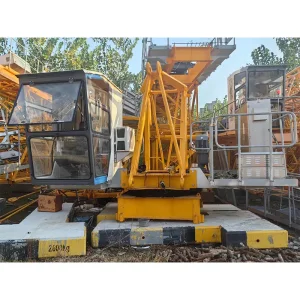
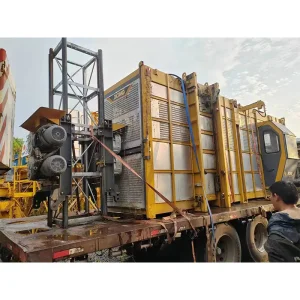
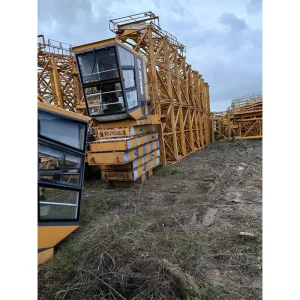
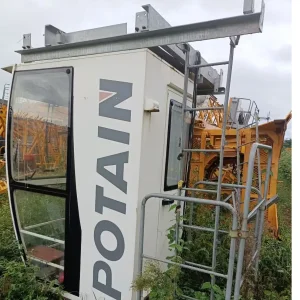
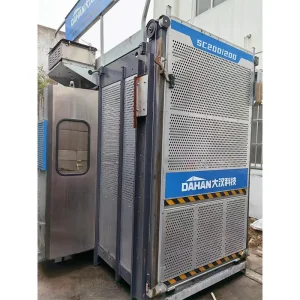
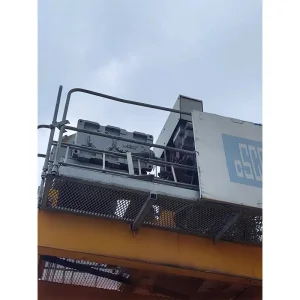
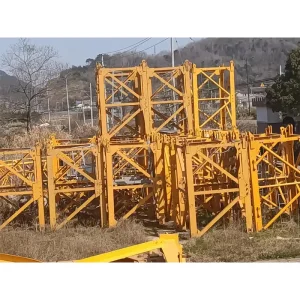
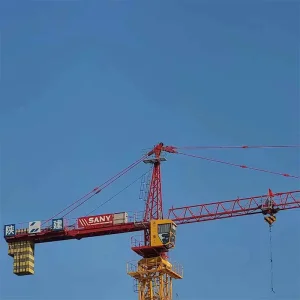
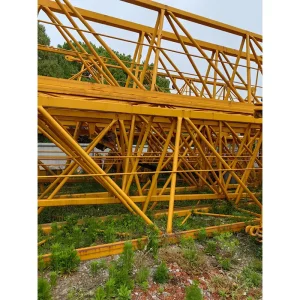
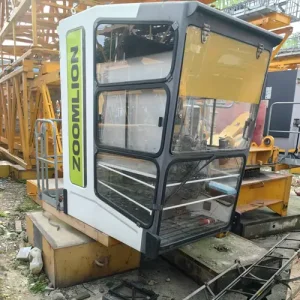
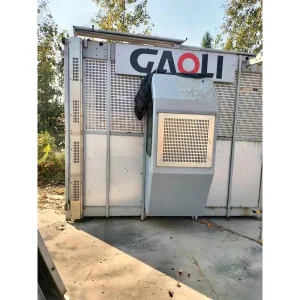
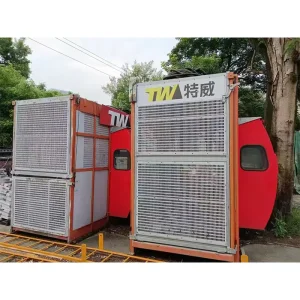
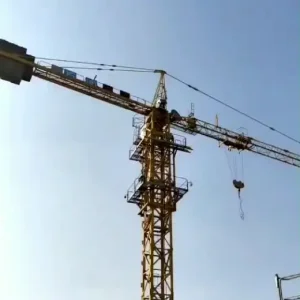
Pre-inspected topkit, flat-top, and luffing-ready structural inventory currently certified for global maritime export from our 30+ acre logistics center.
Understanding how architectural verticality, tighter property boundaries, and air-rights airspace jurisdictions have elevated the luffing crane from a specialized asset to an indispensable urban linchpin.
In modern industrial and commercial construction, the choice of tower crane geometry dictates operational profitability and structural safety. For decades, horizontal saddle-jib (hammerhead) and flat-top (topless) tower cranes dominated global skylines. However, the accelerating rate of hyper-dense megacity urban development across Europe, North America, East Asia, and the Middle East has created an unprecedented spatial crisis. In cities like New York, London, Tokyo, Singapore, and Seoul, construction sites rarely possess boundary buffers. Traditional horizontal jibs, which swing over public avenues, occupied adjacent structures, and sovereign commercial airspaces, increasingly trigger severe municipal airspace trespass litigations and insurance liabilities.
This structural challenge has positioned the luffing jib tower crane at the pinnacle of modern vertical civil engineering. Unlike horizontal trolley systems where working radius is managed along a static horizontal axis, a luffing crane achieves radial positioning via angular elevation of the entire boom—frequently adjusting between 15° to 85° angles. This mechanical freedom allows a 60-meter boom to park or operate within a slewing envelope of less than 15 to 20 meters, completely neutralizing oversailing restrictions above surrounding properties.
Furthermore, the physical dynamics of luffing designs allow remarkable load-moment concentrations. In heavy modular construction, prefabricated precast concrete elements, massive HVAC plant equipment, and structural steel nodes exceed the tip-load limitations of conventional flat-top units. By transferring vertical load vectors directly into the crane’s robust boom lattice and mast pivot pins, luffing cranes manufactured by Chinese industry leaders (such as Zoomlion, XCMG, SANY, and Yongmao) deliver extraordinary heavy-lift duties—routinely managing hook capacities from 12 tons up to 64 tons on demanding supertall skyscraper developments.
Operate cleanly within site property lines. Eliminate oversailing licenses, neighbor airspace disputes, and municipal injunction delays in strict metropolitan zones.
By elevating boom angles independently, multiple luffing units can operate closely on the same footprint without the severe vertical clearance differentials required by flat-top cranes.
Ideal for off-site precast concrete modules and structural steel assembly. Steep boom angles dramatically increase near-mast hook load ratings compared to horizontal cranes.
How state-of-the-art robotic metallurgy, tightly integrated regional supply chains, and stringent OEM validation standards make China the premier exporter of reliable lifting machinery.
The global dominance of Chinese lifting equipment manufacturing is not merely a product of labor efficiency; it is driven by systemic capital investment in smart metallurgy, automated fabrication cells, and complete supply chain integration. Over the past decade, Chinese manufacturers such as XCMG, Zoomlion, SANY, Dahan, and Yongmao have transformed domestic industrial hubs across Jiangsu, Hunan, and Shandong into the world's most advanced heavy equipment clusters.
At the center of this industrial achievement is the mastery of high-tensile structural steel alloys (such as Q355B, Q460C, and HG785D). High-rise luffing cranes undergo intense cyclic fatigue stresses, where angular luffing introduces dramatic dynamic torsion into the slewing ring and mast chords. Chinese OEMs utilize intelligent submerged arc welding (SAW) and robotic multi-axis welding stations that achieve defect-free weld joints confirmed via ultrasonic and radiographic non-destructive testing (NDT). Every crane mast panel is robotically bored to tolerances under 0.05 millimeters, ensuring perfect interchangeability of fishplate pins and pin-sleeve couplings on construction sites worldwide.
Use of proprietary low-temperature impact resistant steels, high-strength manganese alloys, and robotic heat-treating cycles that eliminate microstructural grain boundaries.
Full-immersion blast descaling to ISO Sa 2.5 standards followed by electrostatic fluorocarbon thermoset powder coatings that offer 10+ years of marine anti-corrosion protection.
Hardened gear transmissions with ground-tooth gear pairs (AGMA class 12) driven by stepless variable-frequency frequency inverters for microscopic 5mm millimeter hook control.
Standard engineering compliance with European standard EN 14439, FEM 1.001 structural dynamics, ANSI B30.3, and Australian AS 1418.4 certification frameworks.
Operating from an expansive 30+ acre warehouse and equipment base with over 500 m² of modern engineering administration in Huai’an, Jiangsu Province, Huaian Zhongqiang International Trade Co., Ltd. (founded September 2, 2024, supported by an established leadership pedigree spanning over a decade in crane lifecycle management) represents the vanguard of professional construction machinery exports. Backed by a prestigious Chinese National Level-2 Construction Qualification and holding independent commercial import/export execution rights, Zhongqiang eliminates intermediary trading risks for global EPC contractors.
Every used and late-model (YOM 2018–2023) tower crane and construction hoist from our yard undergoes a non-negotiable 128-point pre-shipment technical inspection. From ultra-precise laser measurement of slewing bearing backlash to ultrasonic testing of root mast fishplates and load brake deceleration dynamometer tests, Zhongqiang certifies mechanical zero-defect reliability before any container or bulk vessel is loaded.
A rigorous structural comparison to guide site planning directors, fleet logistics managers, and structural engineers in choosing optimal tower crane typologies.
| Evaluation Parameter | Luffing Jib Crane (W-Series / DSL) | Topkit Hammerhead Crane (QTZ / MC) | Flat-Top Topless Crane (STT / T-Series) |
|---|---|---|---|
| Operating Slewing Radius | Extremely Compact (5m – 18m min) | Full Boom Fixed (45m – 80m swing) | Full Boom Fixed (45m – 80m swing) |
| Boundary Overflight Risk | Zero (Adjustable boom avoids air rights) | High (Requires neighbor airspace license) | High (Constant circular swing boundary) |
| Near-Mast Heavy Lifting | Superior (Steep angle vectors maximize capacity) | Moderate (Constrained by trolley moment) | Moderate (Limited by tie-rod-less boom moment) |
| Multi-Crane Site Clearance | High density possible with minor height steps | Requires large vertical clearance (8m – 12m) | Requires medium vertical clearance (3m – 6m) |
| Out-of-Service Weather Vaning | Parked at 70°–85° steep angle with low radius | 360° free weathervaning horizontal sweep | 360° free weathervaning horizontal sweep |
| Mechanism Complexity | Dedicated heavy-duty high-speed luffing winch | Standard trolley traverse mechanism | Standard trolley traverse mechanism |
| Ideal Application Scenarios | CBD high-rises, confined plots, bridge pylons | Sprawling industrial yards, infrastructure | Medium urban housing, precast commercial plots |
As demonstrated in the engineering comparison matrix, while Topkit (hammerhead) cranes like the legendary Potain MC120, MC320, and Zoomlion QTZ200/QTZ250 offer exceptional cost-per-ton value and straightforward rigging for vast structural yards or open infrastructure projects, they encounter physical bottlenecks when urban towers exceed 150 meters with tight boundary lines. The Luffing Jib crane solves this dilemma through angular kinematics, converting horizontal cantilever stresses into direct axial mast compression—allowing contractors to achieve maximum lifting efficiency with zero legal disruption.
Analyzing the performance profile of luffing jib cranes across four high-complexity commercial environments.
Surrounded by active commercial boulevards and high-density residential towers, luffing cranes climb internally within elevator shafts or externally with wall-tie collars, ensuring all crane actions stay safely inside the legal site perimeter.
Prefabricated Prefinished Volumetric Construction (PPVC) pods demand hook lift ratings between 15 and 35 tons. Luffing cranes place these massive modules with millimeter precision directly adjacent to the mast tower.
Cable-stayed bridge towers feature steep, tapering geometries exposed to fierce maritime crosswinds. The rigid boom lattice of a luffing crane withstands high wind shear far more effectively than extended horizontal jibs.
Brownfield energy plants, refineries, and airport terminal expansions place severe restrictions on working envelopes. Luffing cranes squeeze inside tight operating bays without shutting down adjacent active infrastructure.
The convergence of artificial intelligence, high-voltage regeneration, and remote sensory telemetry in next-generation Chinese tower crane manufacturing.
Chinese manufacturers are integrating dual-antenna RTK-GNSS, laser-radar LIDAR, and dynamic BIM boundary models directly into crane control consoles. Real-time predictive algorithms anticipate adjacent crane trajectories, autonomously braking or diverting slewing motions to prevent collision incidents on congested multi-rig project sites.
Lowering heavy multi-ton loads creates significant kinetic energy. Cutting-edge variable frequency drive (VFD) hoisting systems employ AFE regenerative converters, capturing gravitational braking energy and returning clean 3-phase electricity to the site grid, cutting operational power draw by up to 28%.
Modern Chinese crane fleets utilize industrial 5G edge gateways to monitor structural health continuously. Wireless strain gauges track fatigue cycles on boom pivots and mast ties, while vibration sensors diagnose slewing ring wear before mechanical downtime occurs—enabling true predictive maintenance.
Essential verification steps every international buyer and plant director must enforce when acquiring heavy tower cranes and construction hoists from China.
International procurement of capital lifting equipment requires far more diligence than standard machinery purchasing. Equipment failures on high-rise construction can lead to catastrophic site shutdowns, structural collapse, and massive liability claims. When sourcing new or inspected used cranes from Chinese manufacturers or trading yards, corporate EPC procurement teams should structure their qualification process across four mandatory operational phases:
Ensure the machine possesses intact original factory nameplates showing genuine Year of Manufacture (YOM), chassis serials, and un-tampered manufacturer load charts from verified OEMs like XCMG, Zoomlion, Potain, SANY, or Dahan.
Execute magnetic particle and ultrasonic testing across critical structural welds on the lower mast sections, turntable slewing rings, A-frame boom head connections, and hoist winch drums to detect metal fatigue or micro-fissures.
Verify that hoisting, slewing, and luffing gearboxes run quietly without tooth backlash. Perform dynamic drop tests on construction hoist anti-fall safety devices and test load-moment limiters against certified test weights.
Carefully supervise dismantling, color-coded section tagging, rust-inhibiting greasing, and customized structural cradling into 40ft Open Top, High Cube, or Flat Rack containers to eliminate maritime transit corrosion and damage.
Expert insights compiled by Huaian Zhongqiang's chief inspection engineers to address overseas contractor procurement questions.
Explore verified heavy lifting inventory from leading Chinese and international OEM brands, fully certified and available for global logistics deployment.
Require customized mast combinations, certified anchor collars, high-tonnage luffing specs, or full containerized sea freight estimates? Our international trade directors respond within 24 hours.