Fully documented, inspected, and load-tested equipment from tier-1 Chinese manufacturers available for immediate export dispatch.
Solving the critical challenges of civil engineering, industrial handling, and precast infrastructure through optimized structural jib architectures and robust kinematic controls.
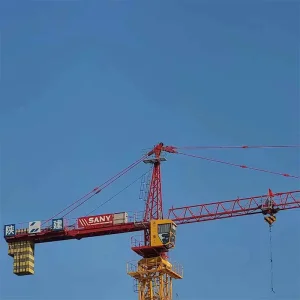
Modern urban skyscrapers demand cranes with high moment capacities and minimal blind spots. Our flat-top and hammerhead jib configurations allow multiple cranes to operate in overlapping radiuses without collision risks, lowering building cycle time by up to 28%.
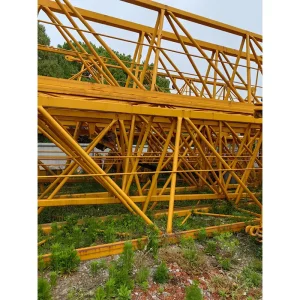
As Precast Concrete (PC) modules become the standard worldwide, tip load requirements have surged from 1.5t to beyond 2.5t. Optimized triangular lattice jibs maintain rigidity under dynamic lateral shear, preventing pendulum effects during placement.
Engineered for bridge pylons, deep locks, and dry-docks. The reinforced slewing rings, anti-torsion chord members, and heavy-duty frequency inverters provide non-step micro-metering capabilities under harsh gale-force conditions.
Understanding the transition toward verified re-manufactured and late-model equipment as a sustainable, capital-efficient alternative to inflated Western OEM backorders.
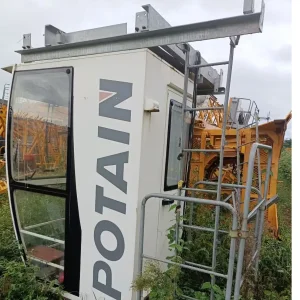
Late-model machines (YOM 2018–2023) from top brands like Zoomlion, Potain, and XCMG deliver 90%+ original duty-cycle lifespan at 40-55% of the purchase price of brand-new units.
While factory backorders for large-tonnage jibs frequently exceed 8 to 14 months, inspected stockpiles in our Huai'an yard can be packed, lashed, and ocean-bound within 10 to 14 business days.
Chinese build factories leverage high-tensile Q345B and Q460 steels, matched with precision robotic submerged-arc welding. This ensures mechanical shear resistance meets or exceeds EN 14439 standards.
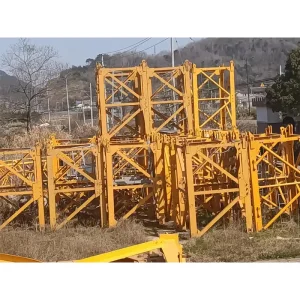
Standardized pin-connected masts, Schneider/ABB electrical drives, and universal wire-rope reeving schemes allow international contractors to source everyday maintenance spares locally without delay.
How Huaian Zhongqiang eliminates cross-border trade friction via rigorous engineering diagnostics, licensed certifications, and end-to-end documentation.
Every structural jib boom, root pin, mast section, and slewing ring undergoes ultrasonic weld inspections and magnetic particle crack diagnostics before export qualification to guarantee structural load safety.
Our entity possesses an official Chinese National Level-2 Qualification and independent customs rights. Buyers contract directly with the asset holder—zero intermediary traders, zero opaque markups.
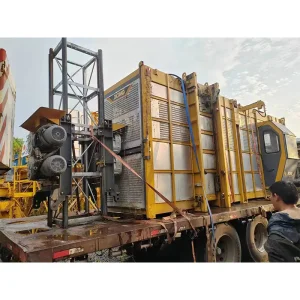
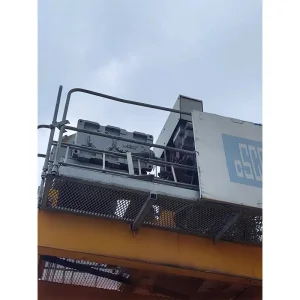
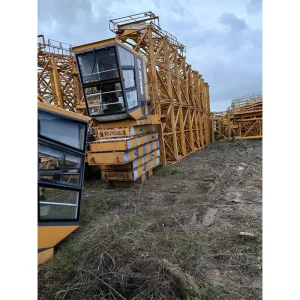
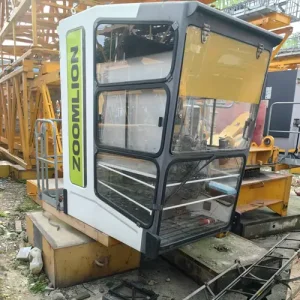
Our dedicated loading teams use custom soft-slings, steel skids, and anti-corrosion marine wraps. Tower crane jibs, counterweights, and cabs are secured to 40HQ/Flat-Rack ocean standards without surface deformities.
Selecting the precise jib configuration, hook speed, and anchor tie-in intervals according to regional climate and architectural blueprints.
For oceanic coastal installations in East Asia and the Caribbean, our QTZ series utilizes specialized wind-relief free-slewing systems that let the jib weathervane freely during storms, avoiding structural overstress.
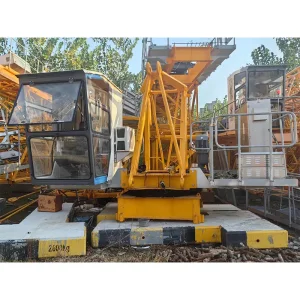
Flat-top jib variants eliminate the traditional crane tower head, allowing cranes on tight European and US commercial sites to clear overhead structures and sweep close under other active crane radii without physical interference.
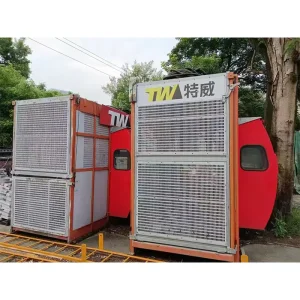
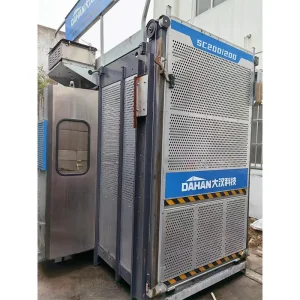
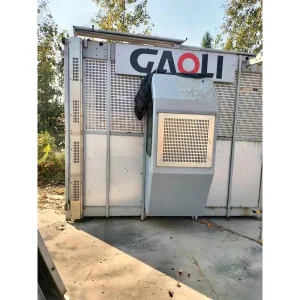
Paired with twin-cage hoists such as DAHAN SC200/200 and GAOLI SC200, contractors achieve continuous personnel movement up to 150m+ with double-fall speed configurations of 0-63 m/min.
Anticipating regulatory updates, telematics monitoring, and intelligent safety innovations in the global lifting machinery ecosystem.
Standardization of real-time 4G/5G diagnostic pods on crane jibs. Real-time logging of hoisting cycles, wire rope fatigue cycles, bearing friction thermography, and anti-collision zoning data transmitted to central cloud telemetry dashboards.
Integration of modular flywheel energy-recovery units and direct regenerative brake circuits into crane winches, slashing diesel generator consumption on greenfield construction sites by over 35%.
LIDAR-guided autonomous hook trajectory correction. Algorithmic anti-sway programming compensating automatically for instantaneous wind-gust drift, ensuring millimetric landing tolerances for modular pod construction.
Direct insights regarding technical specifications, inspection methods, customs documentation, and logistics procedures.
Explore more certified topkit, flat-top, and rack-and-pinion vertical hoists tested and pre-rigged for rapid international installation.