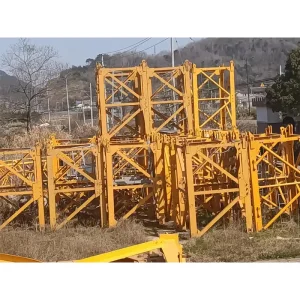
Pre-inspected machinery engineered for internal building climbing, core elevator shafts, and confined structural envelopes with intact OEM pedigrees.
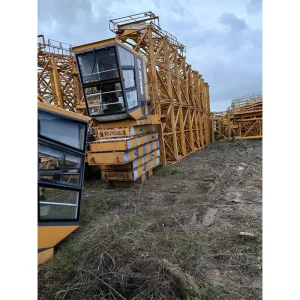
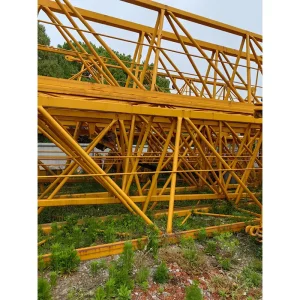
Understanding how floor-climbing systems and internal shaft hoists dramatically reduce structural steel consumption, overcome urban perimeter boundary constraints, and enhance aerodynamic stability.
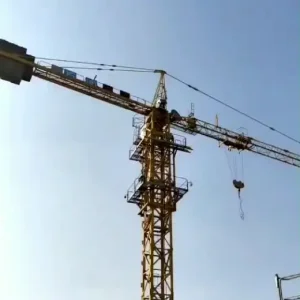
Unlike external tower cranes that anchor directly into the ground and require structural wall-tie brackets every 30 to 50 meters, an internal climbing crane is suspended entirely within the structural core (elevator shaft, shear wall cavity, or stairwell). The crane requires only 28 to 36 meters of total mast height throughout the construction of a 300-meter skyscraper, eliminating hundreds of metric tons of mast section steel.
Vertical deadweights, live operational hook loads, and aerodynamic overturning moments are dissipated across reinforced climbing collars positioned across 3 active concrete floor slabs or internal core walls. Heavy-duty hydraulic cylinders (typically operating at 25-32 MPa) elevate the lower climbing frame, engaging automatic structural wedge dogs and mechanical lock pins into embedded wall pockets.
In dense metropolitan centers such as Hong Kong, Singapore, New York, and Frankfurt, property perimeter air rights restrict external crane foundations and jib swing radius. An inside-the-building crane configuration centers the pivot axis at the building's geometric centroid, optimizing hook coverage while preventing unauthorized swing encroachment over adjacent commercial thoroughfares.
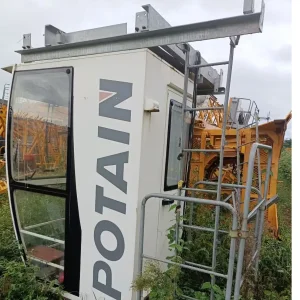
"When specifying an internal floor-climbing configuration (such as the Potain MC120/MC320 or Zoomlion QTZ200/250 series), structural engineers must strictly evaluate the punching shear capacity of the floor slab openings. Chinese factories lead the world in manufacturing ultra-compact climbing collars that distribute horizontal shear loads through multi-point bearing pads, reducing temporary structural steel shoring by up to 40%."
Combining world-class metallurgy, ultra-high-precision robotic welding, and a massive 30-acre inspection yard ecosystem to deliver unbeatable CapEx and operational reliability.
Chinese OEM standards utilize Q355B and specialized Q460D low-alloy, high-strength structural steels for mast cords and jib chords. This ensures immense torsional stiffness and micro-crack resistance under heavy cyclical fatigue within dynamic building cores.
Modern Chinese crane factories employ fully automated submerged arc welding lines and CNC boring machines for mast section pinholes. Connection pin tolerances are kept below 0.1 mm, preventing play and mast vibration during high-speed hoisting.
Operating a massive 30-acre inspection and refurbishment base in Huai'an, Jiangsu, Huaian Zhongqiang International Trade Co., Ltd. exercises rigorous qualification oversight under Chinese National Level-2 Heavy Machinery Operating Certifications.
By interfacing directly with Chinese market giants—Zoomlion, XCMG, SANY, Potain China, Dahan, and Yongmao—we secure complete crane and hoist units (YOM 2018–2023) at 40% to 60% below Western newly built CapEx thresholds.
A rigorous engineering comparison highlighting structural steel consumption, wind exposure, foundation expenses, and overall project economics for high-rise building projects.
| Evaluation Parameter | Internal Floor-Climbing System | External Tied-In Tower Crane | Engineering Impact & Benefit |
|---|---|---|---|
| Mast Steel Consumption | Constant 28–36 Meters | Variable (Up to 300+ Meters) | Eliminates 80–90% of mast section purchase and shipping costs. |
| Foundation Concrete Loads | Transferred to Building Core Slabs | Massive Concrete Footing (100–300 m³) | Eliminates massive exterior ground pile caps and ground-slab penetrations. |
| Aerodynamic Wind Moment | Low (Mast shielded within shaft) | Extreme (Full height exposed to wind) | Internal configurations face far lower vortex shedding and wind load fatigue. |
| Climbing Process & Speed | Hydraulic self-jacking across 3 floors (approx. 2–3 hours per cycle) | Hydraulic telescoping cage; inserting individual sections (6–10 hours) | Significantly reduces crane downtime and eliminates reliance on calm weather windows. |
| Facade Interference | Zero (Exterior facade can close immediately) | Requires tie-back gaps; delays curtain wall completion | Accelerates building envelope sealing and early interior fit-outs. |
| Dismantling Methodology | Requires roof derrick crane or modular descent | Self-telescoping descent or mobile assist crane | Requires careful rooftop derrick planning during pre-construction MEP layout. |
How global contractors deploy Chinese internal climbing cranes and in-shaft construction hoists across diverse structural typologies and complex site conditions.
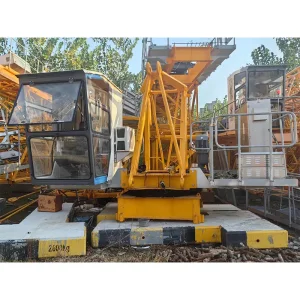
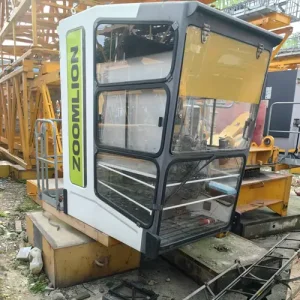
For mega-tall skyscrapers featuring concrete shear core walls with composite mega-columns, heavy topkit cranes such as the Zoomlion QTZ250 (7025-12) or Potain MC320 are locked into climbing frames set inside structural elevator shafts. As core wall climbing formwork (slipform/jumpform) rises, the crane automatically climbs via synchronized hydraulic cylinders, lifting heavy structural steel columns, rebar cages, and concrete placing booms.
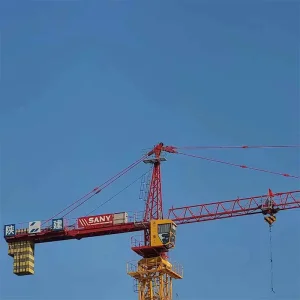
In congested downtown districts where construction sites touch existing roadway borders, sidewalk easements prevent external crane placement. By routing cranes like the SANY QTZ100 (6013-6) or Potain MC120 through interior floor openings, the job site remains entirely self-contained within the structural footprint, preventing perimeter street closures and crane oversail disputes.
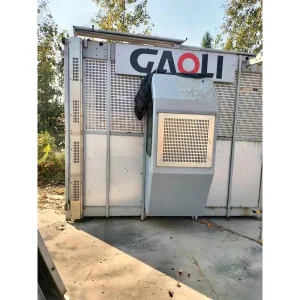
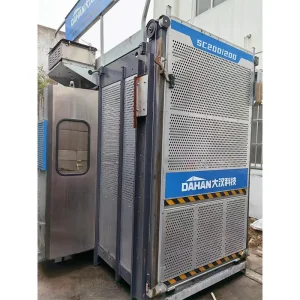
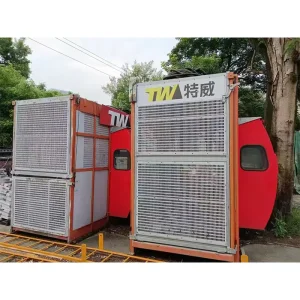
The SC200/200 twin-cage series (DAHAN, XCMG, TEWEI, GAOLI) is frequently installed inside internal elevator shafts rather than on exterior scaffolds. Operating at speeds up to 40–60 m/min with variable frequency drive (VFD) controls, in-shaft hoists remain weatherproof, unaffected by heavy external gales, and accelerate interior finishing work well before curtain walls are enclosed.
How Huaian Zhongqiang ensures every used tower crane and construction hoist meets exacting international civil engineering safety criteria prior to port dispatch.
Before any crane leaves our Huai'an yard, the quality inspection team subjects critical structural weld joints, chord members, and pin lugs to ultrasonic flaw detection and magnetic particle testing. This protocol confirms the absence of internal metal fatigue, micro-cracks, and excessive cyclic stresses accumulated during previous service cycles.
Slewing rings (rotary bearings) undergo precise axial and radial play measurement using dial test indicators. If backlash or tooth wear exceeds OEM allowable thresholds (< 0.25 mm), the slewing ring is completely replaced. Slewing motor pinion alignment and reduction gearboxes are flushed, lubricated, and electrically load-tested.
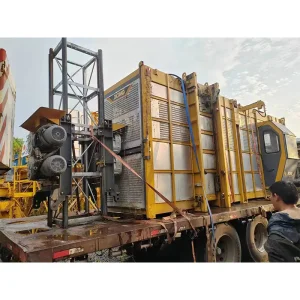
Internal climbing units require customized container loading layouts. Mast sections, climbing collars, hydraulic jacking crossbeams, and jib modules are individually color-coded, labeled in English, and secured onto 40ft High Cube containers or specialized Flat Racks with heavy-duty tension ratchets and timber dunnage to prevent transit distortion.
Direct answers from our senior mechanical and export logistics teams regarding structural loads, climbing mechanics, and procurement logistics.
Explore additional verified equipment from leading manufacturers, fully prepared for immediate international maritime shipment.