Fully inspected, certified operational units featuring precision mast metallurgy, low operating hours, and turn-key export compliance documentation.
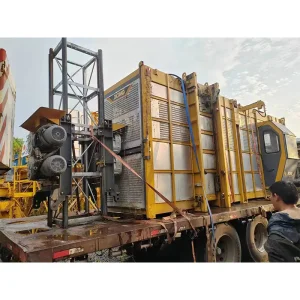
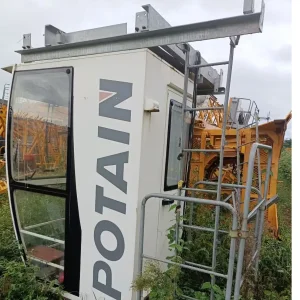
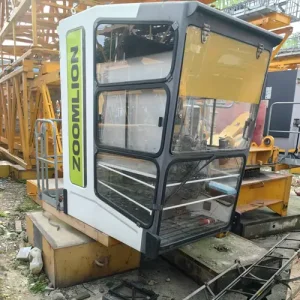
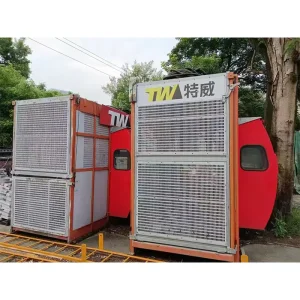
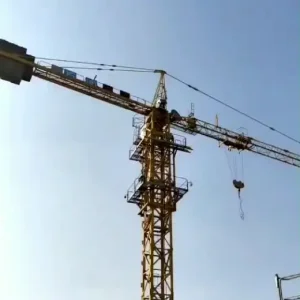
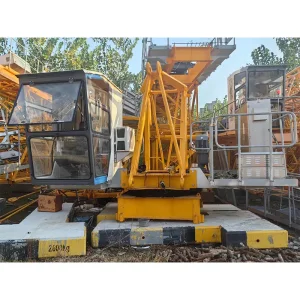
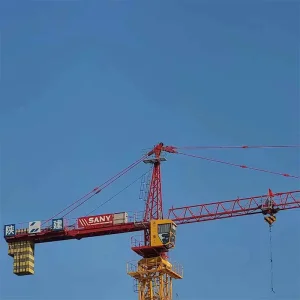
High-density urban skylines and accelerated precast concrete modular construction demand lifting platforms capable of high dynamic torque, millimeter positioning, and internal-core structural self-climbing.
Unlike external anchorage setups that require continuous tie-in collars every 30 to 45 meters against building facades, cranes installed inside the building core (elevator shafts or shear wall cells) transfer load reactions through hydraulic climbing frames directly into reinforced concrete floor slabs. This drastically reduces the total mast sections needed, cutting initial capital expenditure by over 42% on supertall projects.
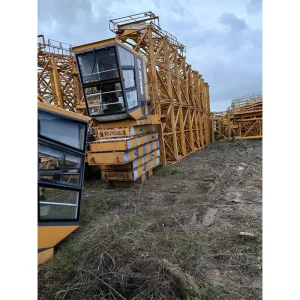
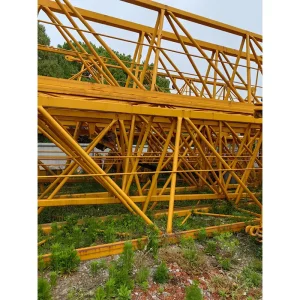
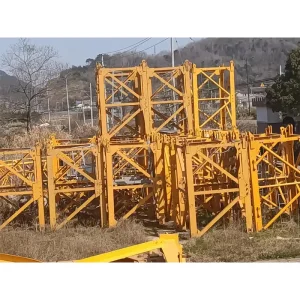
At Huaian Zhongqiang International Trade Co., Ltd., every machine in our 30+ acre warehouse base undergoes stringent ultrasonic flaw detection, magnetic particle testing on critical welded pinholes, and structural deflection checks. Holding a certified Chinese National Level-2 Construction Machinery Qualification, we reject equipment exhibiting plastic deformation, pinhole ovalization, or fatigue micro-fractures.
Operating cranes inside tall structures requires ultra-smooth micro-inching to position precast facade components and volumetric bathroom units (PODs). Sourced OEM systems from XCMG, Zoomlion, Potain, and Yongmao integrate closed-loop vector variable-frequency drives (VFD) ensuring hoist speeds throttle smoothly from 0.1 m/min micro-movement to 100+ m/min free-fall recovery.
Engineering Notice on Structural Loads: When deploying a climbing crane inside a building structure, civil structural engineers must execute load-reaction modeling under both in-service (dynamic lifting moment + horizontal slewing torsion) and out-of-service (storm wind freewheeling up to 60 m/s) scenarios to design localized post-tensioned shoring across 3 to 4 sequential floor levels.
Dedicated Yard Inventory
Pre-Export Quality Protocol
OEM Traceable Assemblies
Global Seaport Network
China produces over 70% of the world's tower cranes and high-rise vertical access hoists. The concentration of automated production lines, premium metallurgical supply chains, and rapid prototyping ecosystems provides an unmatched competitive advantage in global equipment procurement.
Chinese tier-1 crane factories utilize high-tensile fine-grain structural steels (Q345B, Q355B, and Q460D) with superior Charpy V-notch impact toughness tested down to -40°C. Seamless tubular chords and cold-formed angle profiles deliver high strength-to-weight ratios essential for self-climbing crane masts.
Automated multi-axis robotic welding cells perform submerged arc welding (SAW) and gas metal arc welding (GMAW) on mast chords, fishplates, and boom sections. Full-penetration welding protocols minimize internal heat-affected zone (HAZ) stresses and eliminate human inconsistency.
The Chinese domestic supply network offers direct access to planetary slewing gearboxes, hydraulic jacking cylinders with integrated balance valves, Schneider/ABB electrical switchgear, and load torque computers with digital anti-collision sensors, driving rapid maintenance turnaround.
Sourcing factory-inspected, late-model (YOM 2018–2023) equipment via certified trading houses like Huaian Zhongqiang saves general contractors between 50% and 70% compared to purchasing new European machines, without compromising load curves or life cycles.
A comparative technical matrix detailing load distribution, mast section consumption, foundation demands, and site logistics for high-rise commercial structures exceeding 150 meters.
| Evaluation Parameter | Internal Floor-Climbing Crane (In-Core) | External Facade-Anchored Tower Crane | Technical Implications for Site Managers |
|---|---|---|---|
| Mast Height Requirement | Fixed compact height (approx. 30m to 45m total) | Continuous vertical assembly matching building height (up to 300m+) | Internal systems slash mast steel investment by 60–80%. |
| Reaction Force Transfer | Transferred horizontally into core shear walls / slab collars | Transferred into dedicated ground foundation + exterior wall ties | Internal setup requires coordinated temporary slab shoring design. |
| Wind Exposure Profile | Lower wind vortex shedding due to reduced free-standing mast | High aerodynamic drag on tall exposed mast column | In-building cranes feature superior stability during typhoon/high-wind alerts. |
| Curtain Wall & Facade Impact | Zero facade interference; envelope closes unimpeded | Leaves unsealed window slots & punch-throughs at anchor points | Internal systems prevent water leaks and simplify exterior facade completion. |
| Dismantling & Demobilization | Requires rooftop derrick crane or mini spider crane disassembly | Self-telescoping descending cage supported by mobile crane | Dismantling plan must be engineered into the structural rooftop specs. |
| Recommended Building Geometries | Supertall towers (150m–500m), restricted urban plots, circular towers | Mid-rise to high-rise towers (50m–180m) with perimeter space | Crucial for hyper-dense central business district infill projects. |
Exporting heavy machinery requires seamless alignment between Chinese manufacturing standards (GB5144, GB/T 5031) and international engineering codes (EN 14439, FEM 1.001, OSHA 1926.1400, and AS 1418).
All units exported to European and Middle Eastern economic zones include verification of 'out-of-service' wind resistance protocols, automatic weathervaning slip rings, slew brake releases, and dual redundant emergency hoisting limit switches compliant with European Machinery Directive 2006/42/EC.
North American and Caribbean projects require precise English-language documentation of wire rope design safety factors (nominal factor 5.0 for hoist ropes, 3.5 for boom pendents), calibrated anti-two-block limiters, and complete electrical schematic compliance under NFPA 70 / ANSI B30.3 standards.
Huaian Zhongqiang executes direct legal export transactions issuing authenticated Certificates of Origin (CO, Form E, Form A), factory test certificates, stamped commercial invoices, certified packing lists, and original bill of ladings under our independently held export licensing rights.
Modern building methods introduce variable operational dynamics. Below is how Chinese crane and hoist solutions address specific localized structural engineering challenges worldwide.
In dense hubs like Singapore and Hong Kong, PPVC construction dictates heavy hook capacities at long reaches (e.g., 25–40 tons at 35m). Chinese heavy-lift flat-top models (such as Zoomlion QTZ series and Yongmao STT heavy luffers) eliminate jib interference in congested airspace, delivering exact placements within 2mm tolerance.
Projects across Southeast Asia, the Caribbean, and coastal Middle East face severe humidity and typhoon gales. Machines are treated with marine-grade polyurethanes, zinc-rich epoxy primers, and hot-dip galvanized mast options. IP65-sealed electrical cabinets and insulated slewing rings withstand tropical salt-spray corrosion.
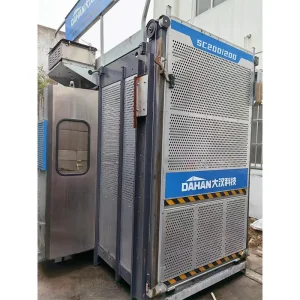
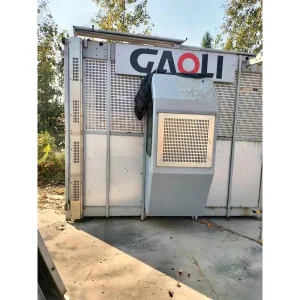
In structures exceeding 200m, worker transit times cut into jobsite productivity. Pairings of SC200/200 twin-cage hoists from XCMG, Dahan, Gaoli, or Tewei feature variable frequencies achieving speeds of 63–96 m/min with energy-recuperating variable drives, ensuring safe transit for up to 4,000 kg or 48 workers per cycle.
How digitalization, intelligent load monitoring, and sustainable drive systems are reshaping modern high-rise crane installations.
Modern Chinese crane setups integrate hook cameras and GNSS receivers with site Building Information Modeling (BIM) platforms. This maps 3D blind-zone paths, providing real-time positional collision avoidance against surrounding structures.
5G low-latency teleoperation allows crane operators to maneuver climbing cranes from climate-controlled ground operations centers via ergonomic joysticks and multi-angle 4K low-latency video feeds, improving safety and shifting protocols.
During heavy hook lowering phases, modern regenerative drives convert kinetic braking energy into clean AC electricity, feeding it back into the building power grid and lowering overall crane power draw by up to 25%.
Vibration sensors and acoustic acoustic-emission detectors mounted near the slewing bearing and hoist gearbox identify gear tooth pitting, bearing race wear, and rope fatigue prior to component failure, enabling true predictive maintenance.
Key questions international project directors, asset managers, and technical buyers ask when purchasing Chinese cranes and construction hoists.
Explore additional verified heavy-duty lifting equipment, complete with full manufacturer provenance, load-moment telemetry, and ready container stowage plans.
Speak directly with our senior heavy lifting export engineers. Receive customized foundation reactions, floor climbing blueprints, and CIF/FOB container freight proposals within 24 business hours.
Headquarters Engineering Direct:
+86 158 6170 3388 / +86 139 5237 6668
Direct 24/7 technical responses via WhatsApp for fast video inspections of physical yard machines.
Direct Export Mailbox:
[email protected]
Submit your jobsite CAD core layouts, lifting radius requirements, and destination seaport for rapid freight and equipment quotation.
Huaian Zhongqiang International Trade Co., Ltd.
Yard Base: West Side of Wenzhou Industrial Park, Qianjiang Road, Huaiyin District, Huai'an, Jiangsu, China.
Office: No. 1 R&D Building, Jianghuai Science and Technology Park.