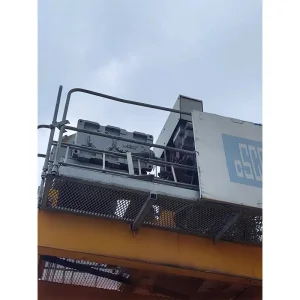
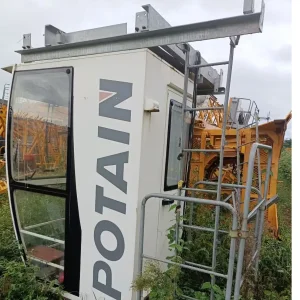
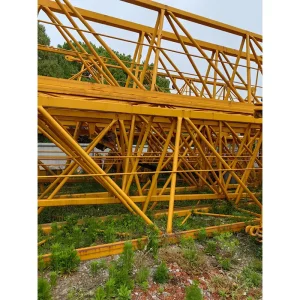
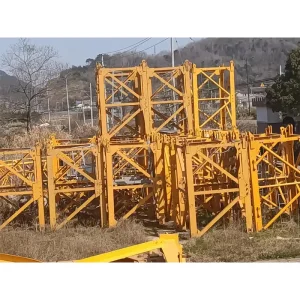
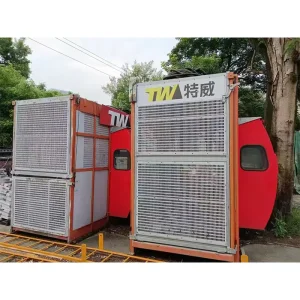
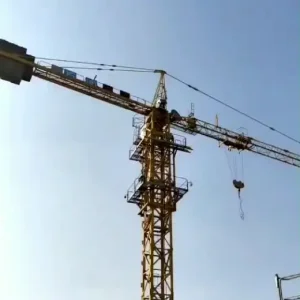
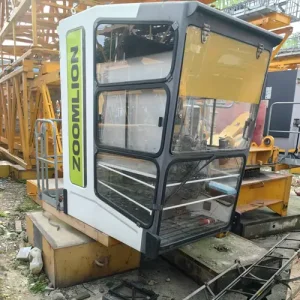
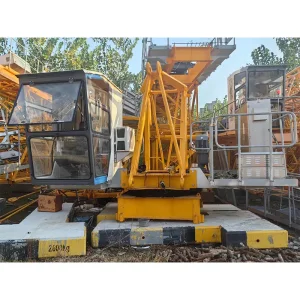
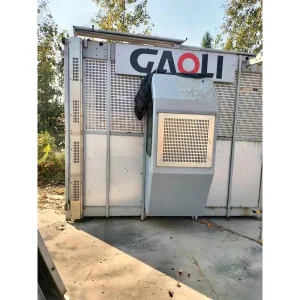
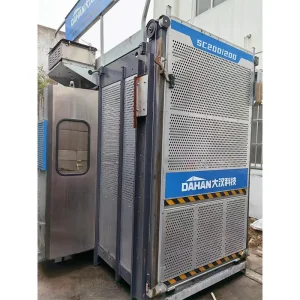
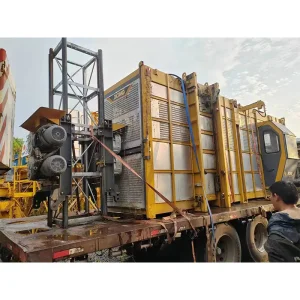
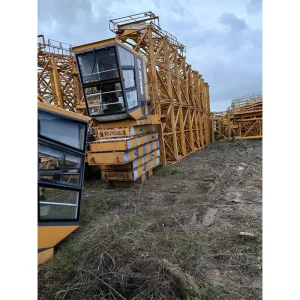
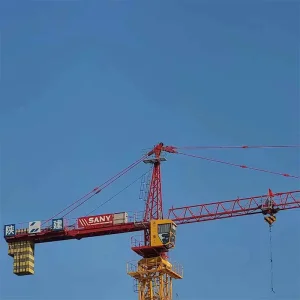
Pre-inspected topkit, hammerhead, and high-speed vertical transportation units. Direct from our 30+ acre logistics hub in Huai'an, Jiangsu, China.
How the convergence of self-erecting agility and fixed tower load moments is restructuring global construction capital deployment.
In modern industrial and urban civil engineering, structural lifting requirements have reached an inflection point. The international construction sector no longer evaluates lifting machinery merely by gross hoisting capacity; rather, operational velocity, site spatial economy, setup cycle times, and lifecycle capital efficiency now dictate competitive advantage. Within this context, the demand for cheap tower mobile crane solutions—defined rigorously by engineering directors not as substandard low-budget equipment, but as high-efficiency, cost-optimized lifting assets that maximize Return on Invested Capital (ROIC)—has surged exponentially across both established and developing industrial markets.
Historically, commercial developers faced a binary procurement dilemma: deploy conventional static tower cranes (such as hammerhead or flat-top topkit variants), which require intricate tie-in engineering, expansive concrete foundation pads, and substantial mobilization times; or contract all-terrain telescopic mobile cranes, which incur staggering daily charter rates and demand wide operating perimeters that trigger urban right-of-way complications. The modern evolution of mobile tower cranes, hybrid crawler-mounted climbing cranes, and rapid-deployment modular tower cranes reconciles this contradiction.
Three primary engineering drivers have accelerated the mainstream adoption of late-model, secondary, and remanufactured heavy tower machinery across global EPC contracting firms:
Modern micro-step VFD hoisting and slewing systems eradicate mechanical shock loading. By transitioning from eddy-current slip clutches to closed-loop vector controls, contemporary cranes reduce wire-rope snapping wear by up to 60% and lower peak electrical grid draw on congested job sites.
Utilizing Q345B and Q460C high-yield structural alloy steels, late-model mast sections replace archaic bolted angles with seamless robotically welded hollow structural sections (HSS). This drastically lowers cyclic structural fatigue while enabling rapid inter-site pin assembly.
Real-time load-moment indicators (LMI) interconnected via CAN-bus architecture monitor slewing angle, trolley radius, wind vector speeds, and rope tension dynamically, preventing dynamic tip-over accidents across dense urban construction clusters.
Why Tier-1 global general contractors are shifting capital from brand-new equipment to factory-inspected secondary OEM cranes.
In an economic climate marked by elevated global interest rates, inflationary steel prices, and compressed builder profit margins, capital discipline is essential. Purchasing a brand-new 10-to-16-ton European or domestic tower crane routinely imposes a initial capital expenditure of $450,000 to $850,000 USD, before factoring in extended factory lead times of 6 to 14 months. For time-sensitive infrastructure bids, such capital lock-in deteriorates cash-flow liquidity.
Conversely, procuring an OEM-grade inspected used tower crane or mobile hoist (YOM 2018–2023) from a specialized direct Chinese exporter like Huaian Zhongqiang International Trade Co., Ltd. yields 40% to 65% upfront CAPEX reduction while preserving 90% or more of the original operational lifecycle. When executed under rigorous metallurgical, ultrasonic, and mechanical verification protocols, this approach provides the highest risk-adjusted yield for heavy contractors worldwide.
| Evaluation Parameter | Brand-New European OEM Unit | Uninspected Spot-Market Broker Unit | Zhongqiang Inspected OEM Asset (YOM 2018-2023) |
|---|---|---|---|
| Initial Capital Outlay (CAPEX) | 100% Benchmark ($480k - $900k+) | 25% - 35% (Unregulated pricing) | 35% - 50% Factory Direct Cost |
| Structural Integrity Assurance | Factory Certificate of Conformance | High Risk (Hidden cracks, metal fatigue) | 128-Point NDT & Ultrasonic Weld Verified |
| Delivery Lead Time | 24 to 52 Weeks Ex-Factory | Variable (Documentation gaps) | Immediate Loading from 30+ Acre Stockyard |
| Electrical / Voltage Adaptability | Standard European Spec (400V 50Hz) | Often Unknown / Inconsistent | Multi-Tap Dual 380V/480V 50/60Hz Transformer |
| First 3-Year Depreciation Loss | 35% - 45% High Value Drop | Unpredictable / Terminal Failure Risk | Minimal (Stable Residual Market Floor) |
How the Yangtze River Delta industrial manufacturing corridor provides unrivaled metallurgical quality, modular compatibility, and reconditioning precision.
The global dominance of Chinese construction machinery manufacturing—anchored by conglomerates such as XCMG, Zoomlion, SANY, Yongmao, and DAHAN—is not an accidental phenomenon driven by cheap labor. Instead, it is the result of three decades of intensive capital investment in Industry 4.0 automated fabrication, continuous submerged arc welding (SAW), robotic plasma cutting, and specialized steel metallurgy. The industrial ecosystem concentrated in Jiangsu, Shandong, and Hunan provinces produces over 70% of the world's tower crane steel structures.
As an international trade operator based in Huai'an, Jiangsu, Huaian Zhongqiang International Trade Co., Ltd. leverages this direct geographical proximity to OEM mother-plants and component tier-suppliers. This structural advantage directly resolves the traditional risks associated with buying "cheap" equipment from abroad:
Every tower crane, mobile climbing frame, and construction hoist entering our inventory passes through a multi-stage audit before export qualification:
Ultrasonic flaw detection and magnetic particle inspection across critical high-stress weld junctions: mast section fishplates, slewing ring pedestals, and jib chord-to-web transitions to ensure zero microscopic fatigue cracks.
Dial indicators verify radial and axial runout clearances of double-row ball and three-row roller slewing bearings against strict ISO 4309 limits, preventing premature gear-tooth failure under cyclic dynamic torque.
Every unit undergo calibrated hoist tests up to 125% of rated load capacity (static proof test) and 110% (dynamic test). We verify instantaneous electromagnetic braking, hook height limiters, and trolley end-buffers.
All structural components undergo shot-blasting to Sa 2.5 cleanliness standards, followed by dual-coat epoxy primer and polyurethane finish coating, providing durability against severe marine transport environments.
Schneider and Siemens-equipped control cabinets are re-wired, checked for insulation resistance (>5 MΩ), fitted with new IP65 weather seals, and tuned for regional voltage variations before packing.
Verification of chassis and mast nameplates against Chinese Ministry of Housing & Urban-Rural Development registration logs, guaranteeing verified Year of Manufacture (YOM) without falsification.
Matching high-moment tower cranes and high-speed vertical hoists to specialized civil and industrial environments.
In congested downtown footprints where street closures are restricted, flat-top tower cranes (such as Yongmao STT153 or Zoomlion QTZ series) eliminate the tall cat-head peak. This configuration allows close-proximity multi-crane slewing overlapping without overhead collision risks, while SC200/200 twin-cage hoists handle simultaneous vertical passenger and material transit up to 250 meters height.
Modern Prefabricated Prefinished Volumetric Construction demands substantial tip-load capacity at broad radiuses. Heavy-tonnage units like the Potain MC320-12 (320 t·m rated load moment) maintain precision micro-inching positioning to place 6-to-12-ton precast bathroom and bedroom modules directly onto anchor bolts without pendulum oscillation.
Riverine, mountainous, and coastal civil engineering projects expose structures to relentless crosswinds and vortex-induced vibrations. Heavy QTZ200 and QTZ250 hammerhead models offer high torsional rigidity along the mast chord, handling anchor tie-in configurations up to 200+ meters alongside suspension bridge towers.
Understanding Chinese National GB/T and international lifting metrics to optimize equipment matching.
Navigating Asian crane inventories requires understanding the engineering logic behind Chinese standard designations. For instance, the widely deployed designation QTZ100 (6013-6) encapsulates all critical mechanical metrics within its code string:
| Symbol Segment | Engineering Specification | Real-World Operational Value |
|---|---|---|
| Q (起重机 - Qǐzhòngjī) | Machinery Classification | Universal designation for Crane machinery according to GB standard |
| T (塔式 - Tǎshì) | Structural Configuration | Tower Crane morphology (vertical cantilever column with slewing jib) |
| Z (自升式 - Zìshēngshì) | Erection Mechanism | Self-raising / Climbing mast hydraulic jacking mechanism equipped |
| 100 (公称起重力矩) | Rated Nominal Load Moment | Approximately 1000 kN·m (~100 t·m) maximum structural bending moment |
| 60 (臂长 - Jib Radius) | Maximum Working Radius | 60.0 meters total horizontal reach from mast centerline to tip |
| 13 (臂端起重量) | Tip Load Capacity | 1.3 metric tons allowable lifting capacity at absolute 60m radius |
| -6 (最大起重量) | Absolute Maximum Hoisting Capacity | 6.0 metric tons maximum hoist capacity (achieved on 2-fall/4-fall close radius) |
Crucial mechanical, metallurgical, logistics, and regulatory answers for international project directors and equipment superintendents.
Engineered construction passenger hoists, topkit towers, and heavy duty lifting solutions available for immediate dispatch.
Combining national level-2 qualification, 30+ acres of real machinery inventory, and end-to-end maritime logistics for global buyers.
Direct communication with crane mechanical engineers, not intermediary sales agents. We provide complete load diagrams, foundation force calculations, and tie-in collar engineering plans tailored to your job site drawings.
Get accurate CIF, FOB, or DAP ocean freight cost breakdowns to any major seaport—including Long Beach, Rotterdam, Singapore, Jebel Ali, Durban, and Santos—within 24 hours of technical inquiry.
Visit our 30+ acre facility in Huai'an, Jiangsu, China to inspect machines under live power, test-run hoisting gearboxes, or coordinate live video walkthroughs with independent third-party inspectors.