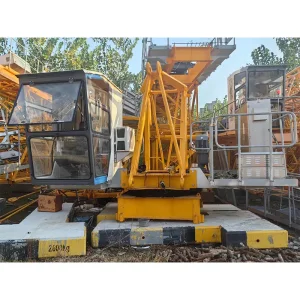
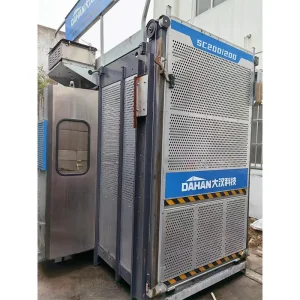
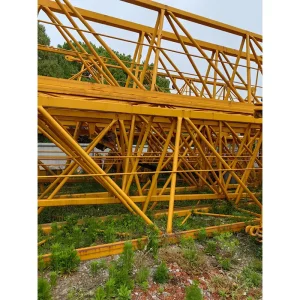
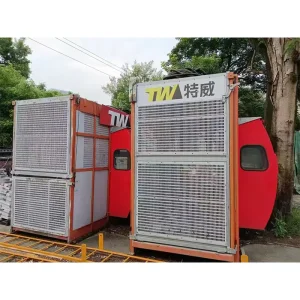
Pre-inspected topkit, flat-top, and passenger/material hoist systems with verified Year of Manufacture (YOM), fully tested slewing releases, and full export compliance certification.
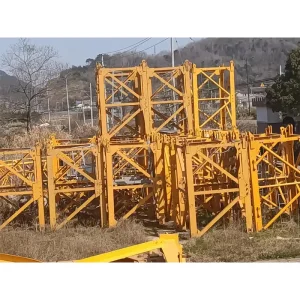
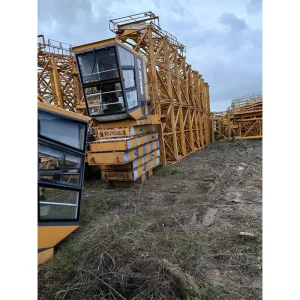

Why modern high-rise tower cranes must automatically orient with prevailing storm vectors to prevent catastrophic torsional stress and foundation overturning moments.
A tower crane in "out-of-service" state operates on the physics of aerodynamic sail balance. The long working jib (typically 50m to 80m) possesses a significantly larger projected wind surface area than the short counter-jib. When the slewing brake is disengaged, the unbalanced aerodynamic drag force produces a corrective yaw moment around the mast axis ($M_w = \Sigma C_d \cdot A \cdot q \cdot r$). This torque naturally rotates the crane until the jib points downwind, matching the path of minimal resistance.
Under international safety standards (EN 14439 and FEM 1.001 Booklet 3), failure to unlock the slewing mechanism out-of-service induces severe torsional shear stress into the tower mast sections. Fixed-slewing exposure during gale winds can amplify base overturning moments by over 340%, risking catastrophic weld cracking, fishplate deformation, or catastrophic mast collapse. Weathervaning systems must incorporate failsafe redundant disengagement.
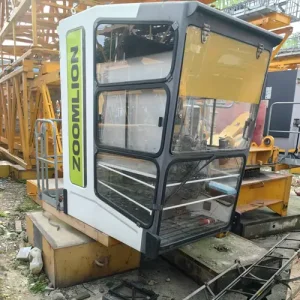
Modern weathervaning requires precision control between free-wheeling rotation and destructive uncontrolled spinning. Premium cranes from Potain, Zoomlion, and XCMG employ electro-hydraulic slewing brake release cylinders paired with eddy-current damping or controlled hydraulic bypass throttling. This ensures that while the crane points downwind spontaneously, sudden directional wind squalls do not spin the upper carriage into harmonic resonance.
An impartial engineering benchmark comparing structural designs, slewing release ergonomics, and harsh-environment durability across global market leaders.
| Manufacturer / Series | Weathervaning Architecture | Wind Survival Rating | Slewing Redundancy | Global Fleet Suitability |
|---|---|---|---|---|
| POTAIN (MC / MDT Series) Manitowoc / France & China |
Hydraulic bypass valve release with passive counter-jib wind sail fin. | Class C25 / C50 (up to 58 m/s) | Dual electro-hydraulic + manual mechanical override lever. | High Interoperability EU, North America, Middle East |
| ZOOMLION (TC / QTZ Series) Changsha, China |
Smart-controlled electro-mechanical slip ring with dynamic torque dissipation. | Typhoon Class 16 (up to 62 m/s) | Integrated PLC auto-disengage on power cutoff + cabin tether. | Heavy Infrastructure Global Megaprojects & Ports |
| XCMG (QTZ / XGT Series) Xuzhou, China |
Permanent magnet eddy current braking combined with free-slew valve. | Class C50 standard (up to 60 m/s) | Triple protection: Spring-applied hydraulic release + bypass. | Harsh Climates High Altitude, Mining, Dense Urban |
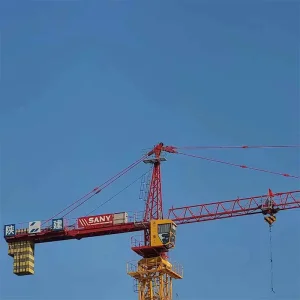
| SANY (SPS / QTZ Series) Beijing, China |
Digital telematics auto-weathervaning with real-time anemometer feedback. | Up to 55 m/s gust resilience | Redundant slip clutches with automated pre-shift diagnostic. | High Efficiency Urban Commercial & Residential |
| YONGMAO & DAHAN Fushun & Shandong, China |
Optimized mechanical brake lifter with balanced aerodynamic jib sections. | Class C25 to C45 compliant | Heavy-duty weighted brake counter-lever with direct manual disengage. | High TCO Value Rental Fleets & Contractors |
Tailored structural configurations designed to resolve complex site logistics where free-slewing radii overlap or coastal storms threaten structural integrity.
In high-density projects where multiple tower cranes operate with overlapping slewing envelopes, unconditional 360° weathervaning presents potential jib collision risks during sudden storms. Zhongqiang supplies cranes with multi-tiered park clearance matrices and altitude-staggered jib setups. Combined with anti-collision zone sensors, each crane is positioned at designated vertical intervals (minimum 3m clearance) so all units can freely rotate downwind without touching neighboring structures.
Island projects and deep-water ports face severe typhoon loads exceeding Category 15 force. Standard friction plates quickly corrode from marine salt spray, potentially seizing the free-slewing bearing. We provide marine-grade sealed slew drives, hot-dip galvanized pins, and heavy-duty auxiliary tail fins (wind vanes) mounted to the counter-jib to amplify yaw sensitivity, guaranteeing immediate directional realignment even when subjected to turbulent offshore gusts.
Internal and external climbing tower cranes installed on supertall skyscraper cores (300m+) experience intense boundary-layer wind turbulence and wind shear gradients. At these elevations, air density and wind vectors diverge dramatically from ground levels. Our pre-inspected equipment features automated anemometric logging telemetry, heavy reinforced mast collars, and high-clearance slewing assemblies built to withstand extreme dynamic fatigue cycles.
Combining the manufacturing volume of China's primary equipment builders with Huaian Zhongqiang's Level-2 certified secondary remanufacturing and non-destructive inspection processes.
Every used tower crane and passenger hoist undergoing export from our Huai'an facility is evaluated via ultrasonic crack testing on mast welds, pinhole ovality checks, slewing raceway clearance tests, and motor insulation resistance audits.
Free-wheeling safety depends entirely on smooth slewing mechanisms. We disassemble, degrease, clean, and re-torque slewing rings, flush electro-hydraulic release blocks, and install new friction discs to guarantee zero sticking when weathervaning is engaged.
Strategically located in Jiangsu Province, Huaian Zhongqiang executes streamlined inland barge, railway, and heavy flatbed road logistics directly to major departure ports (Shanghai, Taicang, Qingdao, and Ningbo), drastically reducing export transit lead times.
No anonymous trading intermediaries. We operate with Chinese National Level-2 Construction Machinery Qualifications and autonomous export rights. Buyers receive certified factory nameplates, genuine YOM certificates, and customs documentation.
A rigorous checklist for commercial developers, general contractors, and rental houses importing used lifting assets into North America, Europe, Asia-Pacific, and Latin America.
Importing second-hand heavy machinery requires transparent chain-of-title paperwork to pass destination port authorities. Zhongqiang facilitates full third-party physical inspections (SGS, Bureau Veritas, or TÜV) right inside our Huai'an yard prior to balance payment release.
To eliminate destination job site delays, all slewing decks, climbing cages, and electrical control cabinets undergo simulated operational testing. Overseas procurement teams who cannot travel to Jiangsu can participate via high-resolution live video commissioning sessions.
Acquiring late-model (YOM 2018–2023) weathervaning tower cranes from Zhongqiang provides up to a 60% capital expenditure discount compared to factory-new units, while retaining 85-90% of their operational design lifespan.
How the convergence of IoT edge computing, predictive weather forecasting, and active aerodynamics is transforming tower crane out-of-service safety.
Next-generation prototypes are replacing passive counter-jib fins with electronically actuated micro-ailerons along the jib chords. Guided by real-time ultrasonic wind sensors, these variable surfaces trim aerodynamic lift and drag, allowing the crane to seek equilibrium faster while dampening high-speed wind buffeting during severe super-typhoon events.
Modern telematics modules automatically correlate on-site digital barometric data with regional Doppler weather radar feeds. Should severe convective microbursts be detected within a 20 km radius, the crane's autonomous safety unit sounds audible site alarms and triggers the slewing release solenoids before dangerous storm fronts strike.
Strain gauge telemetry mounted across lower mast fishplates feeds real-time stress data into cloud-based Digital Twin models. These algorithms track cumulative metal fatigue cycles during out-of-service weathervaning events, predicting the exact residual operating life of structural steel components with unprecedented precision.
Explore additional verified lifting machinery, including heavy-capacity Potain hammerheads, high-speed passenger/material construction hoists, and SANY workhorses.
Practical engineering answers concerning weathervaning procedures, storm protocols, pre-shipment inspections, and international containerization.