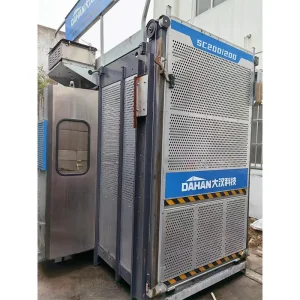
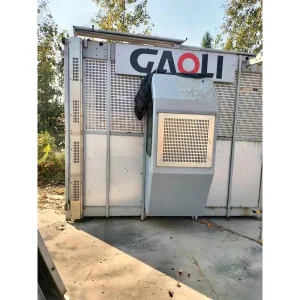
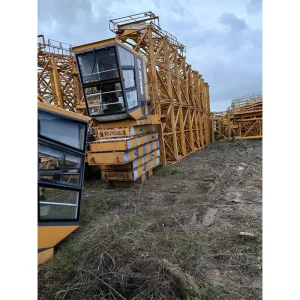
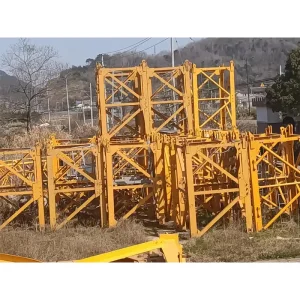
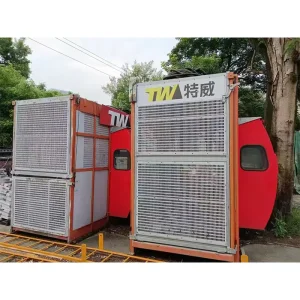
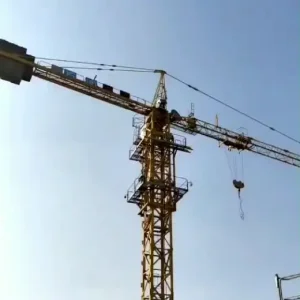
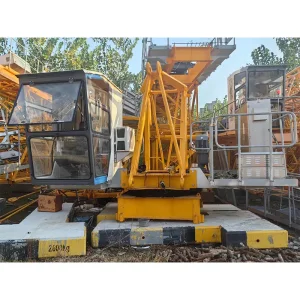
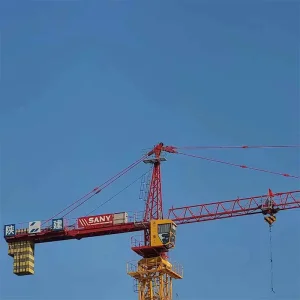
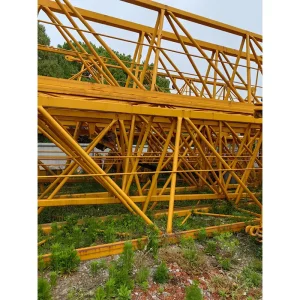
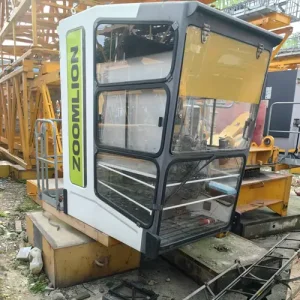
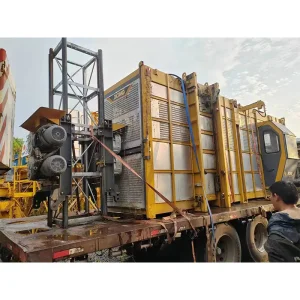
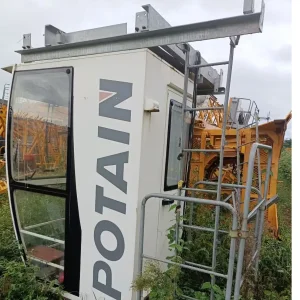
Pre-inspected topkit, flat-top, and vertical hoist machinery available directly from Huaian Zhongqiang's 30+ acre logistics base for immediate overseas sea freight.
As modern metropolitan skylines evolve towards extreme density and supertall civil infrastructure, conventional external anchor-tied cranes face severe logistical and physical bottlenecks. Internal floor-climbing cranes represent the pinnacle of high-rise structural erection efficiency.
By erecting the tower crane inside the building's permanent structural core—typically an elevator shaft or central shear wall—civil contractors eliminate the need for costly external ground foundations, long-reach heavy foundation piles, and massive ground footprint allocations.
Traditional externally climbing cranes require supplementary mast sections that scale directly with building height (exceeding 200m to 400m of steel lattice), complemented by dozens of heavy anchorage frames (tie-ins) that penetrate finished external curtain walls.
Positioning the crane at the centroid of the building footprint maximizes hook efficiency. The trolley hook reaches every perimeter point uniformly with lower moment burdens, empowering contractors to utilize leaner, more energy-efficient topkit or luffing jib models.
A rigorous engineering comparison highlighting why tier-one international general contractors choose internal floor-climbing systems for high-density skyscrapers.
| Evaluation Parameter | Internal Floor-Climbing (Inside Building) | Conventional External Wall-Anchored Crane | Direct Strategic Advantage |
|---|---|---|---|
| Total Mast Sections Required | Fixed: Typically 6–9 standard mast sections (30m–40m total). | Dynamic: Continually added with building rise (up to 80–120+ sections). | Up to 70% freight and procurement cost reduction |
| Foundation Engineering Demands | Supported directly by lower structural floors or core elevator shaft base via climbing beam assemblies. | Requires massive subterranean pile caps, substantial concrete cubic mass, and high bearing capacity. | Drastic drop in early-stage civil capex |
| Facade Impact & Glass Curtain Wall | Zero exterior wall penetration. Building facade can be 100% sealed without waiting for crane removal. | Heavy steel tie-ins penetrate facade every 25–40m, requiring uninstalled curtain panels and post-remedy. | Accelerates building envelope completion by months |
| Wind Resonance & Free Standing Mast Height | Mast is cradled across 2 to 3 floor slabs (approx. 9–12m span). Lateral stiffness is exceptionally high. | Subject to extreme aerodynamic vortex shedding along hundreds of meters of exposed mast steel. | Superior wind resilience in coastal and typhoon regions |
| Climbing Mechanism & Cycle Time | Hydraulic climbing frames with self-supporting jacking cylinders climb 3–4 floors in a single continuous shift. | Requires insertion of new mast sections via hydraulic jacking cage at top heights, exposing crews to wind. | Significantly safer climbing envelope within the core |
| Demobilization & Dismantling | Requires rooftop derrick crane installation to strip jib, counterweight, and lower mast sections down shaft. | Direct unbolting and sequential descent via crane's own climbing cage down to ground level. | Planned early by Zhongqiang via custom derrick systems |
Global procurement teams in North America, Europe, East Asia, and the Middle East face complex trade obstacles when sourcing heavy lifting assets. Huaian Zhongqiang eliminates risk at every transaction node.
Huaian Zhongqiang International Trade Co., Ltd. holds genuine independent Chinese import/export operating rights combined with national level-2 heavy machinery enterprise qualifications. Clients contract directly with the asset holder—zero speculative intermediaries or phantom stock.
Used machinery markets frequently suffer from falsified year-of-manufacture data. Zhongqiang guarantees original factory nameplates, laser-etched serial numbers, and genuine OEM pedigree across Zoomlion, Potain, XCMG, SANY, Yongmao, and DAHAN cranes spanning YOM 2018–2023.
Our dedicated crane dismantling crews personally manage segment packaging. Masts, boom sections, slewing rings, and A-frames are structurally anchored into 40ft Open Tops, Flat Racks, or dedicated breakbulk stowage to prevent maritime transit deformations.
Overseas procurement directors and third-party inspectors (SGS, TÜV, Bureau Veritas) obtain unrestricted on-site access to our 30+ acre yard in Huai'an, Jiangsu, or instant high-definition multi-angle live video inspections covering slewing gear clearance and motor diagnostics.
Zero tolerance for structural failure. Every internal climbing tower crane, climbing frame, and hoist unit undergo a standardized laboratory-grade verification protocol before port transit.
Chord joints, pin-lug connectors, and lattice diagonal welds are tested using non-destructive ultrasonic flaw detection (UT) and magnetic particle testing (MT) to ensure no micro-fissures or stress corrosion cracking exist inside high-stress zones.
Dial indicators gauge internal gear play, axial clearance, and raceway wear on the primary slewing ring. Planetary gearboxes are checked for gear tooth backlash, seal integrity, and synthetic oil contamination profiles to verify long-term fatigue life.
Floor-climbing hydraulic cylinders, pilot-operated check valves, safety pawls, and pump stations are pressure-tested up to 31.5 MPa. Electronic load-moment limiters, slewing limit switches, and anti-collision telemetry receive comprehensive calibration.
Deploying heavy equipment into foreign territories requires strict adherence to international safety codes, customs frameworks, and local building agency protocols.
Zhongqiang exports comply with or exceed European Norms EN 14439 (Safety of Tower Cranes), FEM 1.001 calculation rules, American OSHA 1926.1400, and GB/T 5031. Complete technical manuals and English load charts are provided with every shipment.
Every asset export dossier includes certified Commercial Invoices, Packing Lists with individual component weights, Ocean Bills of Lading, Certificate of Origin (CO / Form E / Form A), and Pre-Shipment Inspection Certificates to guarantee seamless customs clearance.
Because elevator shaft internal dimensions vary per architectural blueprint, Zhongqiang's structural engineering team provides custom-fabricated internal climbing collars, support beams, and matched rooftop dismantling derrick cranes to ensure safe crane demobilization.
The convergence of 5G teleoperation, artificial intelligence, and automated hydraulic self-climbing systems is fundamentally redefining internal building tower crane operations.
Real-time stress sensors embedded in climbing collar beams to monitor live shear and bending loads during active hook slewing, reporting continuous dynamic data via edge gateways.
Operators control internal tower cranes from air-conditioned ground pods using low-latency 5G links and multi-camera panoramic feeds, eliminating high-altitude vertical climber fatigue.
Microprocessor-controlled four-point hydraulic jacking systems that auto-level the mast inside the elevator shaft with millimeter precision during multi-floor climbs.
Computer-vision hook tracking combined with automated swing-damping algorithms to calculate micro-counter-steers, neutralizing pendulum swing in narrow urban core corridors.
Direct technical answers to critical engineering, logistics, and commercial questions raised by international general contractors and heavy lifting directors.
Explore late-model high-capacity tower cranes and passenger/material hoists inspected and certified by Huaian Zhongqiang International Trade Co., Ltd.