Factory-tested, OEM-certified heavy machinery ready for export with pre-shipment NDT inspection.
Evaluating the shift toward modular construction, ultra-tall urban infrastructure, and cross-border equipment procurement dynamics.
In congested metro centers, space constraints mandate flat-top and luffing-jib cranes with zero tail-swing overlap to operate within tightly restricted air rights and complex urban envelopes.
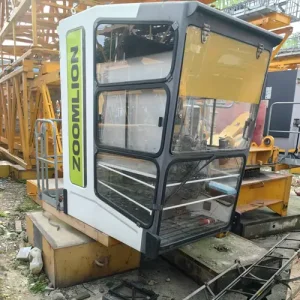
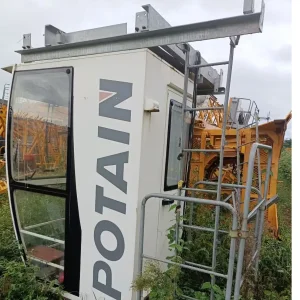
Modern prefabricated building modules weigh between 10 to 25 metric tons, driving demand for heavy-duty tower cranes like the Zoomlion QTZ250 and Potain MC320 series with elevated load-moment ratings.
Exporters must navigate diverse international standards including EN 14439, FEM 1.001, OSHA 1926, and local civil defense regulations to ensure frictionless customs clearance and jobsite commissioning.
Understanding structural variations, slewing mechanism design, load torque metrics, and variable frequency drive (VFD) controls.
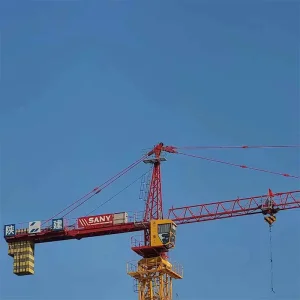
Utilizing a prominent A-frame tower top connected via tie-bars to the jib and counter-jib, hammerhead cranes (such as the Potain MC120-6 and Potain MC320-12) deliver exceptional structural rigidity and linear stress distribution. The tension-pendant system reduces overall jib weight, allowing for higher maximum tip lifting capacity over long working radii (up to 70 meters). These cranes are ideal for isolated job sites where overhead clearance is unrestricted.
Eliminating the conventional tower top and tie-rods, flat-top cranes (such as the Yongmao STT153 7015-10 and Zoomlion QTZ250 7025-12) feature modular jib segments designed to absorb bending moments directly through reinforced chord connections. Flat-top cranes excel in multi-crane jobsites where overlapping slewing radius zones ("tower crane interference") occur. They streamline erection and dismantling using smaller mobile assist cranes.
Engineered specifically for ultra-dense urban environments and high-rise construction surrounded by adjacent structures, luffing-jib cranes raise and lower their working boom dynamically (from 15° to 85°). This drastically reduces the out-of-service slewing radius, allowing powerful lifting operations within extremely constrained site boundaries.
| Model Designation | Structural Type | Max Load Capacity | Jib Length / Tip Load | Load Moment (t·m) | Optimal Application Scenario |
|---|---|---|---|---|---|
| Potain MC120-6 | Top-Kit Hammerhead | 6.0 Metric Tons | 60m / 1.5t | 120 t·m | Mid-rise residential & institutional structures |
| Zoomlion QTZ250 (7025-12) | Flat-Top / Topless | 12.0 Metric Tons | 70m / 2.5t | 250 t·m | PPVC modular build & industrial complexes |
| SANY QTZ100 (6013-6) | Top-Kit Hammerhead | 6.0 Metric Tons | 60m / 1.3t | 100 t·m | Commercial urban infill & bridge pylons |
| Yongmao STT153 (7015-10) | Flat-Top / Topless | 10.0 Metric Tons | 70m / 1.5t | 153 t·m | High-density multi-crane overhead projects |
| Dahan QTZ100 (6013-6) | Top-Kit Hammerhead | 6.0 Metric Tons | 60m / 1.3t | 100 t·m | General civil engineering & frame building |
| Potain MC320-12 | Top-Kit Hammerhead | 12.0 Metric Tons | 70m / 3.2t | 320 t·m | Heavy civil infrastructure, power plants & towers |
Deploying heavy lifting equipment across diverse geographic terrains, climatic extremes, and complex regulatory zones.
Coastal developments in East Asia and the Middle East experience gust speeds exceeding 45 m/s. Zhongqiang supplies cranes configured with high-tensile Q460 steel mast sections, storm slewing release mechanisms, and anemometer-linked automatic braking systems to ensure maximum stability under severe weather conditions.
Operating in ambient temperatures reaching 50°C requires specialized electrical cabinets equipped with air-conditioned cooling loops, heavy-duty VFD heat sinks, and IP65-rated sealed enclosures to protect sensitive PLC control systems against sand ingress and thermal tripping.
Low-temperature operations (-25°C to -40°C) demand specialized impact-tested manganese steel chords to prevent brittle fracture, along with synthetic low-pour-point gear oils, heating elements in slewing gearboxes, and fully insulated operator cabs.
How Huaian Zhongqiang leverages Eastern China's machinery manufacturing ecosystem to deliver unrivaled cost-to-performance value.
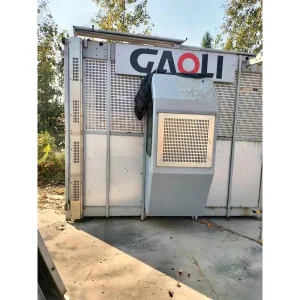
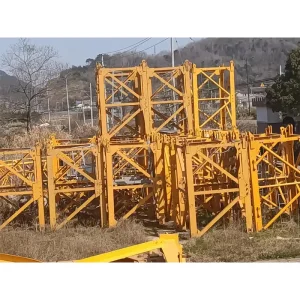
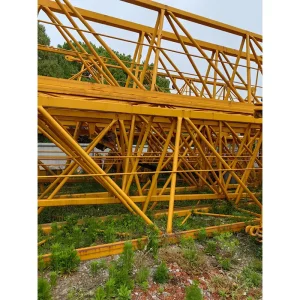
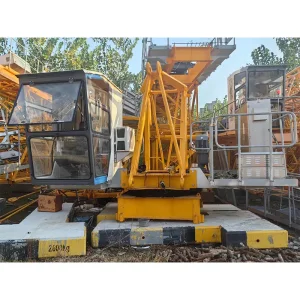
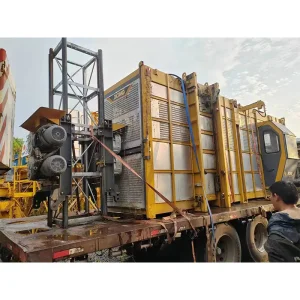
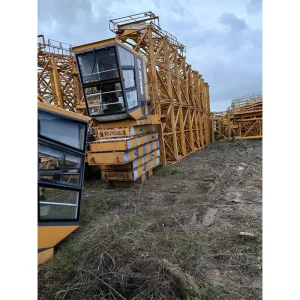
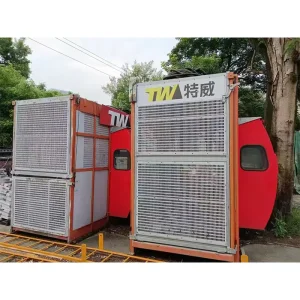
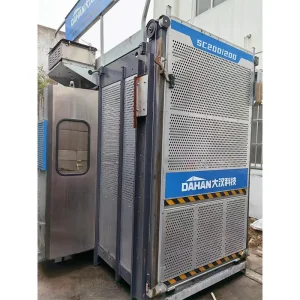
Maintaining an extensive physical footprint in Huai'an, housing hundreds of inspected mast sections, jib components, mechanisms, and passenger hoists ready for immediate containerized shipping.
Every used machine undergoes mandatory ultrasonic non-destructive testing (NDT) on structural welds, slewing ring bearing clearance measurement, and full electrical load testing prior to disassembly.
Sourcing YOM 2018–2023 certified equipment reduces initial capital expenditures by 40% to 60% compared to new European imports, dramatically boosting Return on Invested Capital (ROIC).
In-house logistics teams manage dismantling, anti-corrosion marine packaging, container bundling (40HQ / Flat Rack), export documentation, and port clearing at Shanghai and Qingdao.
Meeting strict global structural, electrical, and operational safety criteria for seamless site commissioning.
Equipped with redundant mechanical and digital limit switches controlling maximum load moment, maximum weight limiters, trolley travel boundaries, and upper/lower hook height limits to prevent structural overloading.
Integrated free-slewing (weathervaning) hydraulic brake bypass systems allow the crane jib to align naturally with prevailing storm winds when out of service, mitigating torsional stress on the mast base.
Shipments include original manufacturer nameplates, structural integrity inspection reports, wire rope test certificates, foundation load reaction diagrams, and multi-lingual operator manuals.
The integration of IoT telemetry, AI anti-sway algorithms, telemetry digital twins, and green electrification.
Closed-loop sensor networks utilize IMU accelerometers and computer vision cameras placed at the trolley and hook block. AI algorithms automatically adjust motor torque outputs in real-time, eliminating load sway and reducing cycle times by up to 25%.
Sensors monitor slewing gear vibration profiles, motor temperature curves, wire rope diameter wear, and electrical current harmonics. Data is transmitted to cloud dashboards, predicting component fatigue before mechanical failure occurs.
Next-generation VFD hoist drives incorporate regenerative power modules that capture kinetic energy during heavy load lowering, feeding clean electricity back into the site grid and reducing total power consumption by 15–20%.
Explore our complete available inventory of inspected tower cranes and construction hoists.
Direct authoritative answers on technical specifications, international shipping, quality assurance, and site erection.