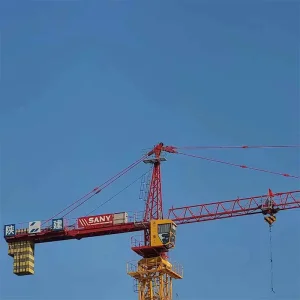
Pre-inspected hydraulic climbing mechanisms, verified year of manufacture (YOM 2018–2023), and structural mast sections staged for immediate containerized or breakbulk maritime dispatch.
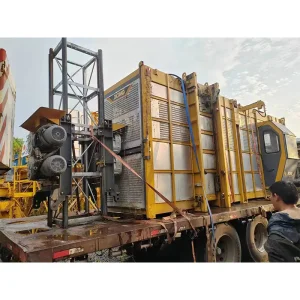
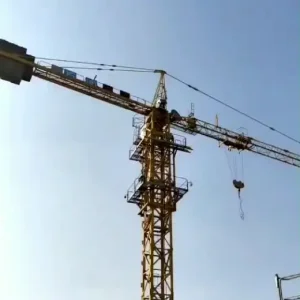
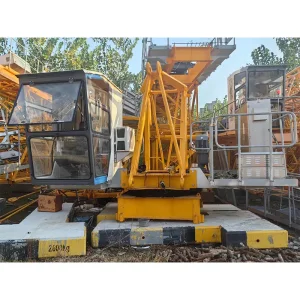
A jacking tower crane represents the pinnacle of modern vertical civil construction engineering. Unlike stationary or external mobile cranes that are constrained by fixed boom heights, a self-jacking tower crane increases its freestanding height autonomously via an external telescoping cage or an internal climbing collar framework.
The jacking frame surrounds the mast column and utilizes high-pressure hydraulic cylinders with integrated counterbalance holding valves. During climbing operations, the upper crane assembly (slewing table, operator cab, tower top, counter-jib, and working jib) is balanced perfectly around the center of gravity, unpinned from the lower mast, and lifted incrementally by single-stroke hydraulic cylinders (typically rated between 250 kN to 600 kN capacity).
Before initiating cylinder stroke extension, the crane’s superstructure must attain a neutral moment equilibrium. The operator positions a specific counterweight balance block or a test ballast load along the jib radius. Electronic inclinometers and hydraulic pressure transducers verify that the overturning moment on the mast axis approaches absolute zero before mast pin disengagement.
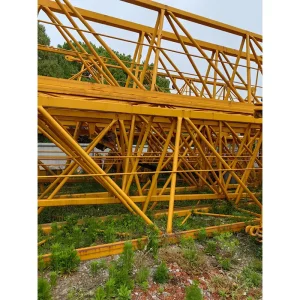
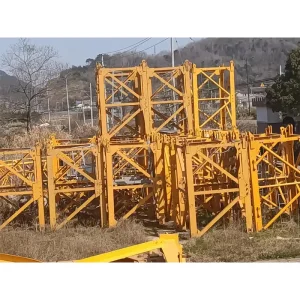
When exceeding the OEM-specified freestanding height (typically 40 m to 60 m depending on mast cross-section, such as 1.6m × 1.6m or 2.0m × 2.0m), anchor ties (strut collars) are introduced. These triangulated structural steel ties transmit horizontal wind shear forces and torsional slewing reactions directly into the core walls of the building superstructure.
Evaluating load charts, slewing torque, tip load capacities, and hydraulic climbing speeds across leading enterprise equipment families sourced by Huaian Zhongqiang International Trade Co., Ltd.
| Model Class | OEM Manufacturer | Max Capacity (t) | Jib Length / Tip Load | Freestanding H (m) | Standard Mast Section | Hydraulic Jacking Unit |
|---|---|---|---|---|---|---|
| QTZ100 (6013-6) | SANY / XCMG / Dahan | 6.0 t | 60 m / 1.30 t | 40.0 m | 1.6 m × 1.6 m × 2.8 m (Pin/Bolt) | External Telescoping Cage (18.5 kW) |
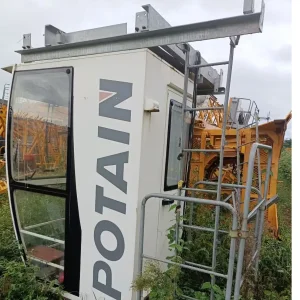
| MC120-6 | Potain (Manitowoc) | 6.0 t | 60 m / 1.15 t | 44.0 m | L46A1 / 1.6 m Monobloc / Panel | Hydraulic Cylinder with Fall-Arrest Pawl |
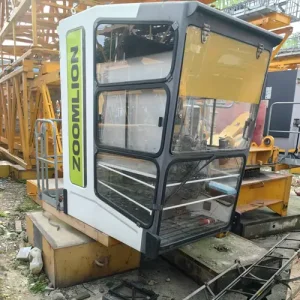
| QTZ200 (7020-12) | Zoomlion Heavy Industry | 12.0 t | 70 m / 2.00 t | 53.5 m | 2.0 m × 2.0 m × 3.0 m (High Tensile) | Self-Climbing Hydraulic System (30 MPa) |
| QTZ250 (7025-12) | Zoomlion Heavy Industry | 12.0 t | 70 m / 2.50 t | 60.0 m | 2.0 m × 2.0 m Fishplate Mast | Integrated Telescoping Assembly (37 kW) |
| STT153 (7015-10) | Yongmao Machinery | 10.0 t | 70 m / 1.50 t | 48.0 m | Flat-Top Specialized Mast Segment | External Climbing Frame with Load Sensors |
| MC320-12 | Potain (Manitowoc) | 12.0 t | 70 m / 3.20 t | 50.4 m | 2.0 m Reinforced Heavy Sections | Dual-Latching Pawl Telescopic Device |
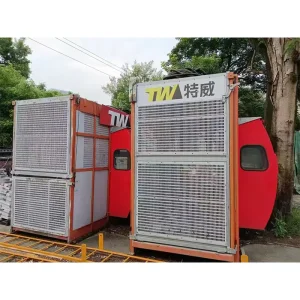
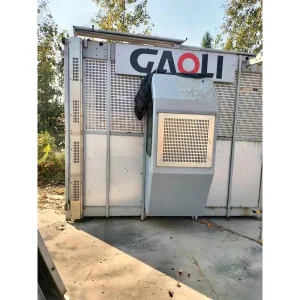
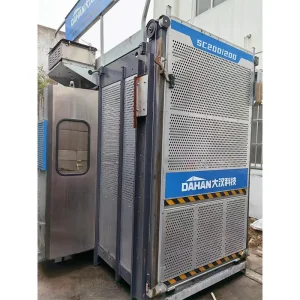
| SC200/200 Hoist | XCMG / Tewei / Gaoli | 2 × 2.0 t | Twin Cage 0–40 m/min | Freestanding 9.0 m (Max 450 m) | 0.65 m × 0.65 m × 1.508 m | Progressive Fall-Arrest Safety Device (SAJ) |
Procuring used and late-model (YOM 2018–2023) construction equipment internationally demands absolute transparency. Huaian Zhongqiang International Trade Co., Ltd. operates a centralized physical yard in Jiangsu, applying non-destructive testing (NDT), dimensional laser alignment, and full electrical bench testing before clearance.
Comprehensive magnetic particle inspection (MPI) and ultrasonic testing across all primary welds, slewing bearing bolts, and main chord fishplates.
A dedicated equipment yard located in Huai'an, Jiangsu, facilitating direct buyer visits, third-party SGS/TÜV audits, and live video structural inspections.
Original factory nameplates intact, factory serial verification, unadulterated manufacturing years, and complete mechanical operating service records.
Multimodal sea routes leaving East China ports (Shanghai, Qingdao, Lianyungang) directly to Asia-Pacific, Middle East, Europe, and the Americas.
Our headquarters holds an official Chinese National Second-Level Heavy Machinery Operating Qualification, coupled with direct export rights. Contractors deal directly with the inventory holder, completely bypassing middle-tier brokerages, hidden commissions, or unverified brokers.
All export machinery packages include verified Bill of Lading (B/L), Certificate of Origin (Form E, CO, etc.), Commercial Invoices, Packing Lists with individual component weights, and optional Third-Party Pre-Shipment Inspection (PSI) Certificates.
The global construction industry is transitioning rapidly toward smart construction sites, Building Information Modeling (BIM) integration, and autonomous self-climbing crane operations. Explore the key technological trajectories modernizing tower crane supply chains.
Traditional climbing cycles require manual adjustments by highly skilled riggers to balance the superstructure. Next-generation jacking setups incorporate multi-axis closed-loop servo controllers that automatically shift the trolley position in micro-increments, compensating in real-time for wind loads and dynamic thermal expansion.
Modern jacking cranes exported through Huaian Zhongqiang can be retrofitted with intelligent IoT remote monitoring boxes. Structural strain gauges, hydraulic pump temperature sensors, and vibration spectrum analyzers continuously transmit telemetry data to site engineers, predicting fatigue cracks before structural failure occurs.
Energy recovery units (ERUs) attached to high-power hoisting winches (such as Zoomlion's 55 kW and Potain's RCS hoists) capture kinetic energy dissipated during heavy payload descents. This reclaimed energy feeds back into auxiliary hydraulic jacking pumps, slashing job site diesel generator fuel consumption by up to 28%.
Heavy machinery export success hinges upon precision component packing and marine cargo lashing. Our certified in-house rigging crew handles every crane dismantling cycle, providing color-coded tag matching, weatherproof shrink wrapping, and precision flat-rack container stowage.
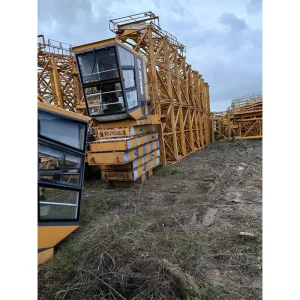
Standard mast sections (1.6m monobloc or panelized kit sections) and jibs are loaded into 40-foot High Cube (40'HC) containers. Jibs are nested using heavy-duty timber dunnage and rubber isolators to eliminate transport friction.
The slewing ring unit, jacking telescoping cage, and main hoisting mechanisms are lashed onto 40-foot Flat Racks (40'FR) or accommodated in breakbulk cargo holds using certified high-tensile steel wire ropes and turnbuckles.
All electrical control cabinets (PLC, inverters, contactors), open hydraulic cylinder chrome rods, and slewing gears receive anti-rust wax coatings and moisture-barrier vapor corrosion inhibitor (VCI) shrink wrap for long ocean crossings.
Every consignment is shipped under verified Incoterms (FOB, CFR, CIF, DAP). Full customs dossiers include original Bills of Lading, Certificate of Conformity, Commercial Invoices, detailed packing lists, and fumigation certificates.
Explore additional verified equipment from our Huai'an distribution yard, including high-capacity Potain hammerhead tower cranes, Zoomlion flat-top cranes, and twin-cage vertical passenger hoists.
Key insights on model coding, telescoping cylinder checks, electrical system adaptation (50 Hz vs. 60 Hz), and international warranty assistance.