Explore eight certified industrial lifting systems and construction hoists held in our Huai'an yard, pre-evaluated across 128 safety parameters.
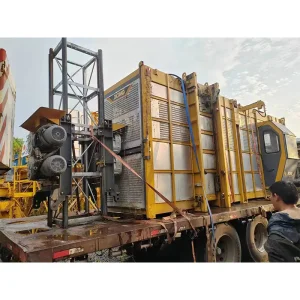
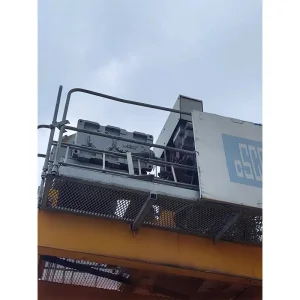
A comprehensive examination of what happens inside modern tower crane manufacturing facilities, from chord steel extrusion to precision planetary slew rings.
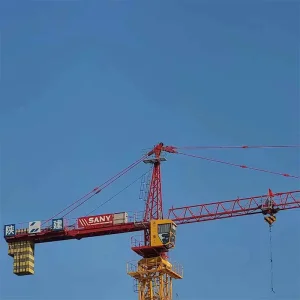
Understanding the internal anatomy of high-capacity tower cranes separates casual machinery traders from professional industrial solution providers. At Huaian Zhongqiang International Trade Co., Ltd., our engineering methodology evaluates the fundamental life-cycle stress distribution across every critical subsystem. Inside a world-class OEM manufacturing line—whether DAHAN, Yongmao, XCMG, SANY, or Zoomlion—the assembly begins with the chemical and structural integrity of main chord profiles. These chords are constructed from high-tensile structural steels such as Q345B, Q355B, and manganese-alloyed Q420 steel, designed to withstand severe cyclic bending moments, wind shear vibrations, and low-temperature brittle fracture.
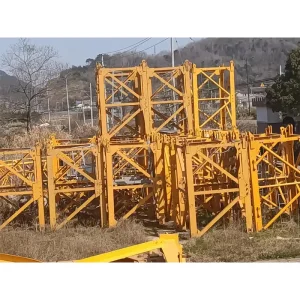
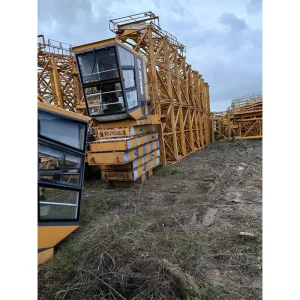
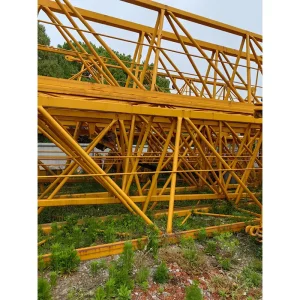
Mast sections are formed using automated submerged arc welding (SAW) and robotic multi-axis jigging, ensuring dimensional variance does not exceed 0.5 millimeters across an entire 3-meter or 4-meter pin-to-pin junction. When analyzing an inspected crane inside our 30+ acre logistics center, ultrasonic non-destructive testing (NDT) is executed to inspect internal chord butt welds for micro-voids, slag inclusion, and micro-cracking caused by torsional stress.
The slewing mechanism features double-row roller or four-point contact ball slew rings with internal/external induction-hardened helical gear cut teeth. We measure tooth backlash and axial play to ensure compliance within DIN 15018 and ISO 4301-1 fatigue thresholds.
High-torque hoisting winches utilize multi-layer grooved Lebus spooling drums that prevent wire rope crushing. We inspect non-rotating compacted strand cables for core fractures, diameter reduction, and corrosion.
Modern crane cabins act as digitized mission-control centers. Dual-core PLC control cabinets operate over CANopen or Profinet industrial fieldbus lines, synchronizing digital load moment indicators (LMI) with millisecond-accuracy.
Why China's modern manufacturing hubs and secondary machinery reserves provide an unrivaled balance of cost, precision, and delivery speed.
The transformation of China's heavy equipment manufacturing over the past decade represents a quantum leap in engineering maturity. Modern Chinese crane gigafactories run automated production lines featuring laser plate cutting, dual-arm welding cobots, shot-blasting chambers with zinc-rich primer automation, and infrared-cured polyurethane coating ovens. As a result, cranes produced between YOM 2018 and 2023 exhibit metallurgical fatigue life, paint adhesion, and component longevity on par with European legacy giants, while maintaining total cost of ownership advantages of 35% to 55%.
As a professional exporter headquartered in Huai'an, Jiangsu, Huaian Zhongqiang International Trade Co., Ltd. capitalizes on this industrial density. Holding our own direct import and export operating rights and a Chinese national second-level operational qualification, our base is linked to the industrial shipping corridors of Shanghai, Qingdao, and Lianyungang. This geographical and structural setup ensures that verified machines are sourced, structurally inspected, overhauled, packaged, and containerized without third-party broker friction.
Every tower crane requires immediate access to interchangeable parts throughout its lifecycle. China's integrated supply chain ecosystem allows our team to supply replacement slewing ring pinions, mast tie-in collars, counter-jib anchor pins, and PLC inverter boards with lead times measured in days rather than months. We maintain dedicated component repositories within our 30+ acre facility for XCMG, Zoomlion, Potain, SANY, and DAHAN cranes.
Second-hand export success hinges on objective quality assurance. Before any machine is cleared for sea transit, our internal inspection engineers deploy magnetic particle flaw detectors on high-stress tension chords, calibrate load test weights across double and four-fall reeving lines, perform electrical thermal-imaging scans to identify contactor overheating, and flush all hydraulic fluid lines to prevent contamination.
The evolutionary trajectory of horizontal jib cranes, luffing jibs, and smart construction hoists through 2030 and beyond.
Future iterations of topkit and topless tower cranes increasingly interface with 4G/5G industrial IoT gateways. By establishing digital twins of the crane structure, sensor networks transmit continuous real-time stress cycles, anchor bolt pre-load readings, and motor winding thermal signatures to central cloud platforms for predictive maintenance.
Advanced algorithmic sway dampening is becoming standard on Tier 1 cranes. Utilizing LiDAR hook-position feedback and closed-loop inverter motor management, these systems automatically counter-steer trolley and slewing speeds to cancel pendulum payload motion, decreasing cycle times by up to 28%.
Ground-based command pods equipped with high-definition multi-angle cameras and haptic controls replace physical cabins at high elevations. This transition eliminates operator fatigue during vertical transit in high-rise construction, enhances job-site safety, and standardizes multi-crane coordination across tight urban plots.
| Evaluation Parameter | Conventional Mechanical Cranes | Current Late-Model (YOM 2018–2023) | Next-Gen Industry 4.0 Ecosystem |
|---|---|---|---|
| Drive Control | Resistor step-speed control | Full VFD stepless inverter control | Permanent magnet synchronous motor (PMSM) |
| Structural Health Monitoring | Manual physical gauge checks | Load cell LMI + wind velocity sensor | Integrated fiber-optic strain & vibration arrays |
| Collision Prevention | Visual line-of-sight & radio signals | 2D radar obstacle zoning barriers | 3D point-cloud LiDAR & autonomous path planning |
| TCO & Energy Efficiency | High peak power draw, heavy brake wear | Regenerative braking energy recovery | Hybrid supercapacitor power stabilization |
Engineered configurations adapted to urban civil construction, deep-water bridge pylons, industrial energy plants, and prefab modular building schemes.
Prefabricated modular building methods require elevated tip load capacities to lift precast concrete slabs, volumetric bathroom pods, and steel modules. In this sector, cranes such as the Zoomlion QTZ250 (7025-12) or Yongmao STT153 provide exceptional radius coverage, rigid mast deflection stability, and micro-positioning capabilities essential for locating tie-in pins on structural foundations.
Long-term civil infrastructure projects require cranes with large free-standing heights, heavy maximum lifting moments (ranging from 160 t·m to 320 t·m), and extreme corrosion-resistant coatings. Units like the Potain MC320-12 and Zoomlion QTZ200 operate reliably in adverse open-channel wind fields, equipped with specialized mast tie-ins to withstand high gust factors.
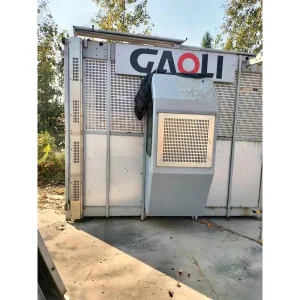
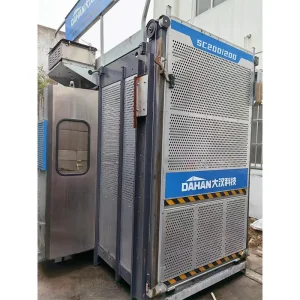
Efficient high-rise construction relies on a balanced operational flow: tower cranes transport bulky structural elements while vertical construction hoists (such as the XCMG SC200/200, DAHAN SC200/200, and GAOLI SC200/200) rapidly ferry labor, drywall, masonry, and equipment. Synchronizing these two material flows cuts crane wait-time bottlenecks by upwards of 40%, safeguarding project critical path deadlines.
How Huaian Zhongqiang eliminates cross-border logistics friction through thorough technical verification and complete legal documentation.
We prepare export dossiers aligned with destination customs brokers, including Commercial Invoices, Packing Lists with marked container breakdowns, clean on-board Ocean Bills of Lading, Certificates of Origin (CO, Form E, Form R), and third-party inspection certificates from agencies like SGS or BV upon request.
Disassembly is executed by our dedicated in-house loading crew. Mast sections, slewing units, counter-jibs, and cabins are systematically tagged with alphanumeric identifiers. High-cube containers (40' HC) and heavy-duty Flat Racks are packed with ISPM-15 heat-treated fumigated dunnage, high-grade steel tension banding, and vapor-phase corrosion inhibitors (VCI).
Grid standards differ across international markets. Our electrical engineers calibrate crane transformers and inverter firmware to match target electrical configurations (e.g., 380V/50Hz, 440V/60Hz, or 480V/60Hz), preventing undervoltage tripping, phase-loss errors, and motor overcurrent failures on overseas job sites.
Why Tier-1 late-model used cranes (YOM 2018–2023) consistently outperform both brand-new builds and older unverified machines in financial return.
For international contractors, plant equipment managers, and heavy-machinery hire organizations, capital expenditure decisions demand strict ROI analysis. Purchasing brand-new tower cranes from Tier-1 European or premier Chinese OEMs introduces heavy balance-sheet burdens, substantial initial depreciation (30–40% across the initial 24 months), and lengthy factory lead times of four to eight months. Conversely, acquiring low-cost, unverified older machines (pre-2015) risks hidden metal fatigue, outdated relay-logic controls, and high project-delay expenses.
The optimal procurement sweet spot lies within certified YOM 2018–2023 inventory. These units have absorbed their steepest initial depreciation while retaining 80% to 90% of their operational design life. At Huaian Zhongqiang, our late-model cranes include original OEM nameplates, intact maintenance records, and state-of-the-art VFD controls, all at a fraction of brand-new pricing. They can be inspected live on our 30+ acre yard, cleared through customs, and dispatched to global ports within two to three weeks of order confirmation.
Acquiring late-model used machinery conserves upfront cash reserves, freeing up capital for site mobilization, foundation concrete engineering, and labor deployment.
Avoid lengthy factory backlogs. Inspected machines in our Huai'an yard can be packed and dispatched to primary marine terminals like Shanghai Port within days.
Late-model cranes from reputable OEMs (Potain, Zoomlion, XCMG, SANY) maintain high liquidity and resale value upon project completion.
Review our extended inventory of checked lifting machinery ready for containerization and worldwide dispatch.
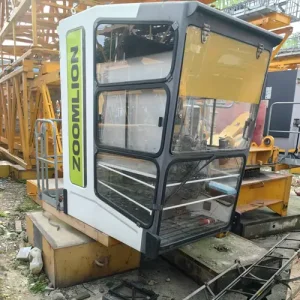
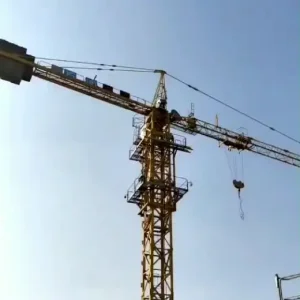
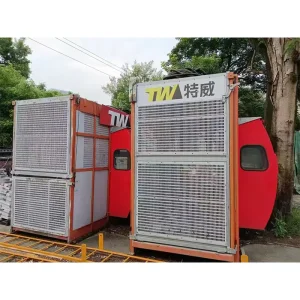
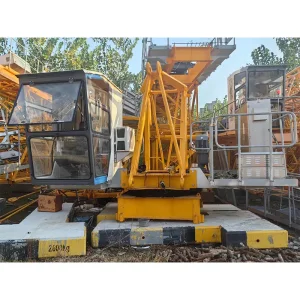
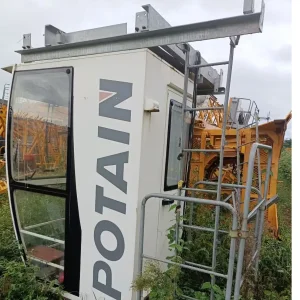
Direct technical and logistical insights addressing common questions from international engineering contractors, fleet managers, and procurement officers.
A specialized heavy-machinery export facility backed by over ten years of industry expertise and a Chinese National Second-Level Operational Qualification.
Founded on September 2, 2024, in Huai'an, Jiangsu Province, our company maintains an active heavy-equipment stock yard exceeding 30 acres alongside modern R&D and operational offices spanning over 500 m². We specialize exclusively in topkit hammerhead tower cranes, flat-top cranes, passenger/material construction hoists, and heavy civil construction machinery.
We hold direct, government-sanctioned import and export trading rights and maintain a Chinese National Level-2 Qualification. International buyers work directly with our engineering and logistics teams, avoiding multi-tiered trading agents while securing full component accountability and direct shipment scheduling.